
I must confess that I usually take against films that adopt a pamphleteering style and wear their ideology too openly, even when I share their ideas and causes. But in Beatrice Gibson’s At Night, the militancy asserted from the very beginning becomes a virtue, since that militancy is itself up for debate. Through its free-form structure, the film establishes itself as a refreshing and highly original work within contemporary cinema. In certain respects, particularly in its commitment to just and widely publicised causes, it approaches contemporary trends in the performing arts. This is not a film devoted to a single cause, but to multiple causes that emerge in rapid succession in the Parisian underground. The word underground is also literal here, as the film visually explores the Paris Métro.
At Night constructs itself freely, unconcerned with narrative conventions, occupying a territory close to that of the documentary essay. At several moments, it evokes Chantal Akerman, through its personal and uninhibited gaze, but also through the subliminal presence of the maternal figure.
The film unfolds in layers. From the very beginning, we understand that we are entering the underworlds of Paris. This is a cinema that looks towards the margins, while seeking people on those margins who are capable of articulating their own discourse, endowed with a political consciousness that enables both sociological reflection and self-reflection. In other words, people who, amid the daily turmoil of struggling to survive, still find room for structured thought.
In the first layer, we encounter a filmmaker searching for her own film. It is a personal diegesis. Beatrice Gibson is an Anglo-French filmmaker based in London who finds herself in Paris, far from her family, with the task of making her first feature film. It is worth noting that she has already built a remarkable career in short films, winning several significant awards. There is an existential, almost identity-based drama here, in which the creator’s anguish is presented with considerable rawness and projected onto the world. She is a filmmaker committed to causes, and she brings together six women around them, all with rich histories of activism and feminist rebellion.
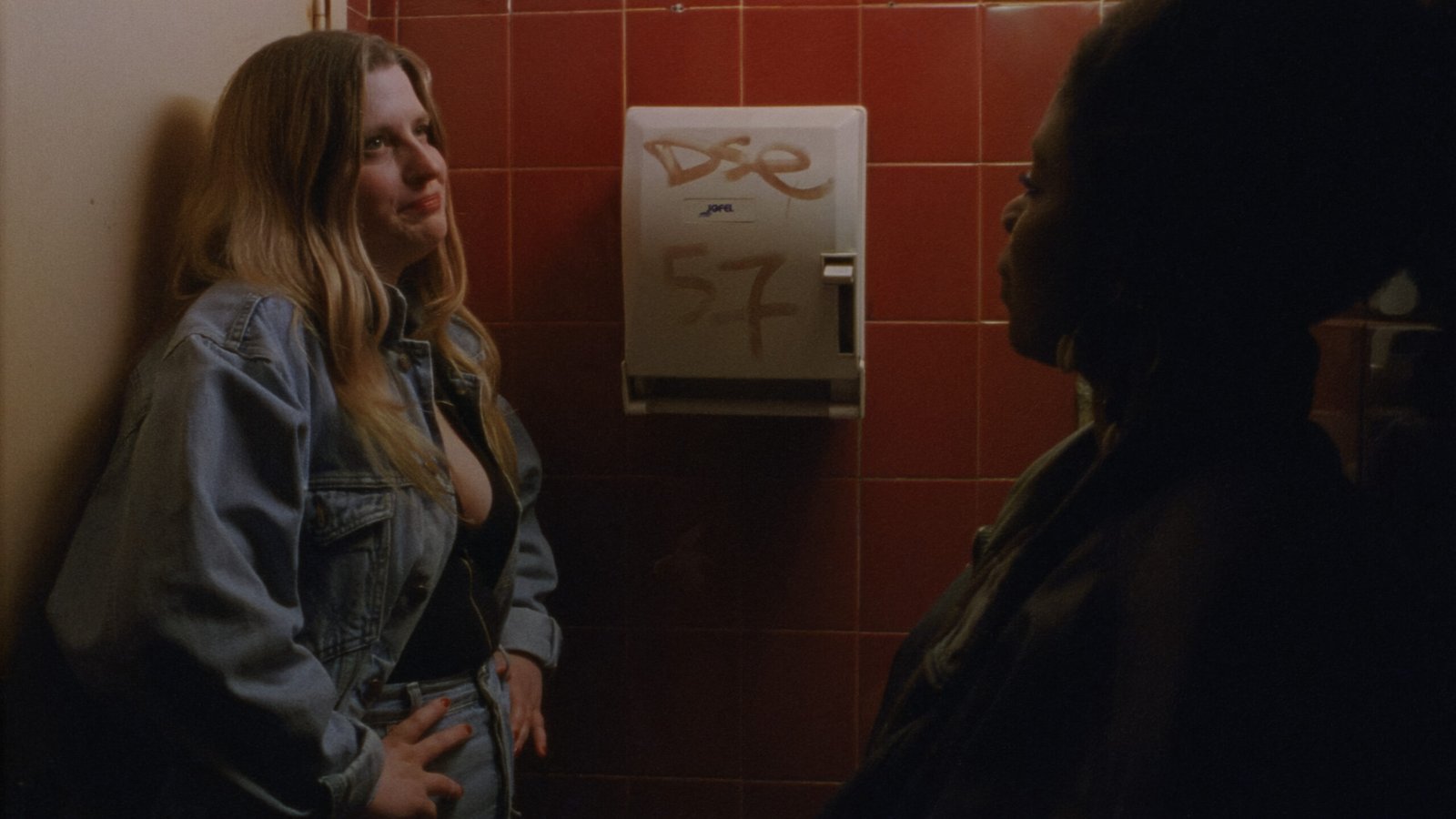
Feminism asserts itself very clearly and almost solemnly. One particularly striking scene shows the women sitting in a Parisian bar and, in a distinctly Akermanian style, discussing sexual desire and the family, drawing upon theoretical concepts from both past and present. Ti-Grace Atkinson’s maxim, “Feminism is the theory, lesbianism is the practice,” is revived as a means of discussing heterosexuality. Someone once again challenges the conservative, bourgeois concept of the family, defending new, socially constructed forms of kinship. It is at this point that Didi, Diocouda Diaoune, Black, from the outskirts and with nowhere to live, yet always possessed of a coherent and politicised discourse, counters that, for a Black woman from the outskirts, the very idea of family is almost a utopia.
Didi asserts her marginal condition, as though opening up a new level within the cause: if women are socially discriminated against, what does that mean for Black women in Western societies? She even confronts the filmmaker directly, telling her: “You always win.”
From that point onwards, something ingenious and unusual happens. Beatrice withdraws from the film to make room for Didi. It now becomes Didi’s film.
Didi wanders through Paris at night and encounters other margins. She discovers the world of cross-dressing and trans identities, people pushed even further towards the periphery than she is. It is the underworld of the underworld. She gives them space to tell their stories, reveal their faces and assert their voices. Perhaps, by the end, Didi is a little less alone.
At Night is an avowedly political, essayistic and reflective film that questions the model of French society and Parisian society in particular. It exposes social, racial, gender and sexual-orientation discrimination. It ventures into the world and its underworlds. Constructed as a sweeping gesture of freedom, it almost suggests a French Angela Davis, capable of leading a movement, an ideal figure of the Left: the Black woman who has been attacked but remains defiant, who fights, reacts and articulates an urgent and coherent political discourse.
Visually, the film is made with great freedom and beauty. The 16 mm camera, operated by cinematographer Ben Rivers, lends texture and depth to its images of the Parisian underground at night. The film draws us into its polemical momentum, making room for the Other, whom we may never be able to reach fully, but to whom we can at least give a voice.
At Night (Reino Unido/França, 2026, 87 min.)
Realização e argumento: Beatrice Gibson | Fotografia: Ben Rivers | Montagem: Liyo Gong | Música: Elvin Brandhi | Som: Dana Farzanehpour | Produção: Scott O’Donnell, Denna Cartamkhoob e Beatrice Gibson | Com: Diocouda Diaoune, Beatrice Gibson, Kátia Belo Cardoso, Sophie Robinson, Amy Gwatkin e Alice Notley.