

And so it is that one such voice finds you, “The Voice of Hind Rajab,” an Oscar-nominated film banned in India due to concerns that it may spoil bilateral relationships with Israel. Written and directed by Tunisian filmmaker Kaouther Ben Hania, the docu-drama recreates the events surrounding the actual voice recording of six-year old Hind Rajab as she spoke to staff from the Red Crescent, while caught under Israeli Defence Force fire in Gaza.
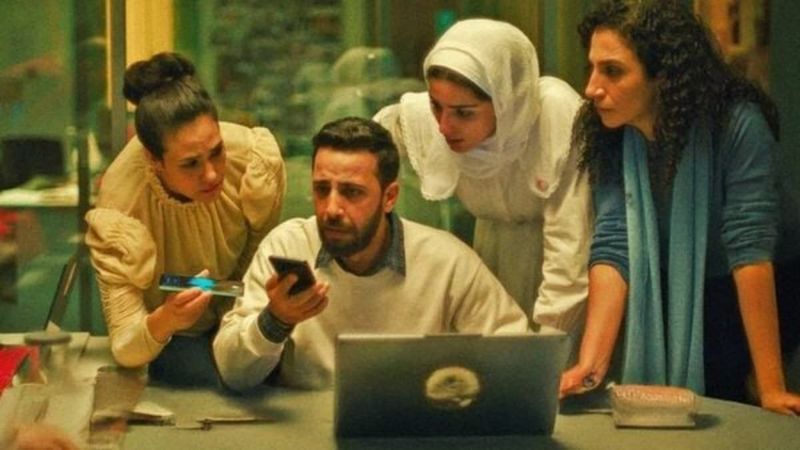
Hind’s first contact at the Red Crescent is with Omar (played by Moataz Malhees), who is soon willing to move away from protocol in order to send an ambulance to save the child. Omar finds himself at loggerheads with the coordinator Mahdi (Amer Hlehel) who is far more cautious, having previously lost his team in rescue attempts. Herein lies the tussle between a direct call to action and prudent one.
Rana (Saja Kilani) is the other rescue respondent that speaks to Hind. She comforts her with endearments and half-truths about how rescue is near. As night draws near, we hear the fear in Hind’s voice, and the increasing frustration and helplessness felt by the staff, who plead with Mahdi to send help. While we cannot see the protagonist, the rescue team’s faces are seen in close-ups and extreme close-ups with the camera moving unsteadily, mirroring the precarity of her situation.
At one time Hind stops speaking. The Red Crescent is given clearance and an approved route to reach Hind. Mahdi appears to be heartless at that moment, as he refuses to instruct the ambulance to move because Hind may no longer be alive.
Hope springs up again when we hear Hind’s voice. Euphoria and energy fills the screen.
What follows is the most heartbreaking moment of the film. After clearance from the relevant authorities – a process explained by Mahdi in the film – when the ambulance approaches Hind’s vehicle, they receive a green light, presumably a clearance to move ahead. Despite knowing how it ends, the audience is still shocked by the attack, where the rescue workers and Hind Rajab are all killed.
The film switches between documentary footage and dramatisation, where we realise the fate of Hind Rajab and the rescue workers, one that Mahdi had feared and tried to prevent from the start. The story mirrors our political scenario, where the oppressor does not keep promises, only continues in its project to destroy. Meanwhile, Hind Rajab’s very own voice reaches out to us through the film and beyond, where we are made to question protocols and our caution. Her appeal is as urgent and earnest as that of Palestinians in Gaza and beyond, “Why don’t you come get me?”
The movie ends, but Hind Rajab’s voice will ring in our ears for posterity.
It is a voice that cannot be silenced.
Note: After this review was published, the ban on The Voice of Hind Rajab was finally lifted in India following public pressure.