
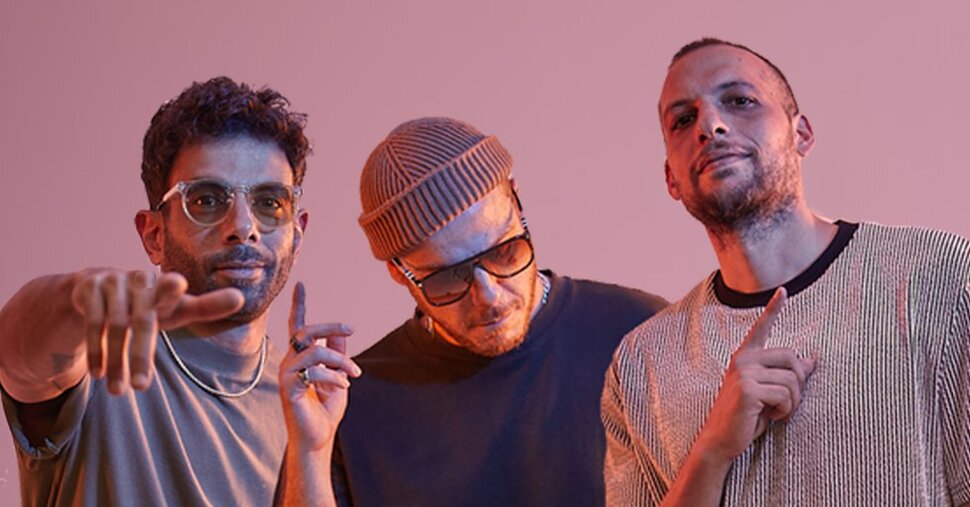
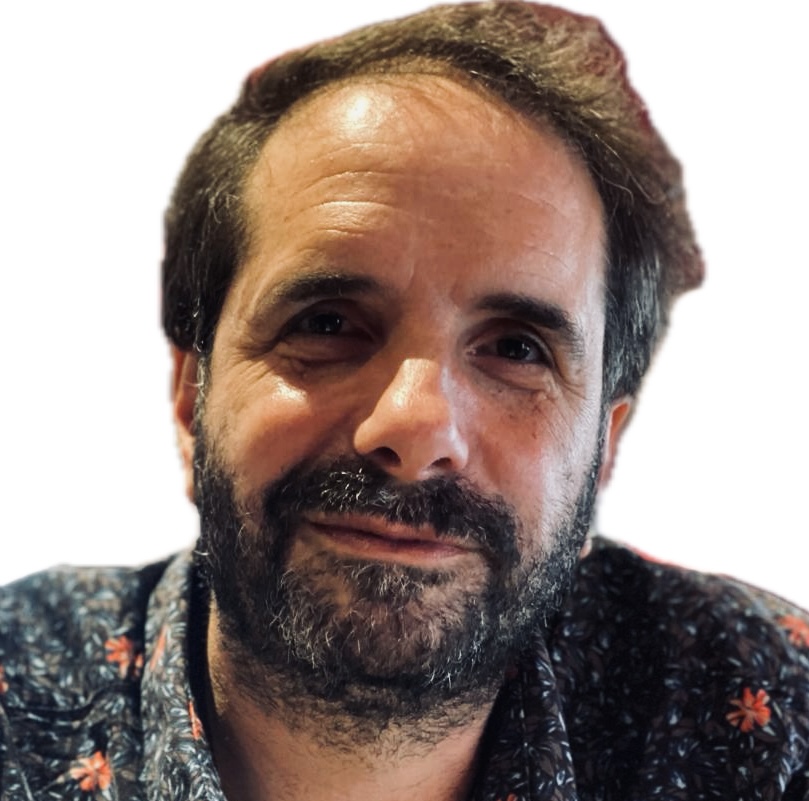
They are one of the most acclaimed bands of the Palestinian diaspora and pioneers of a musical style that became known as Shamstep, blending hip-hop with elements of traditional Arab music and other influences such as reggae. Formed in Jordan in 2013, 47Soul have since released the albums Shamstep, Balfron Promise, and Semitics, performing around the world with powerful lyrics that affirm Palestinian culture while denouncing the Israeli occupation and the ongoing genocide. Backstage at the Festival Músicas do Mundo in Sines, where they closed the programme at the Castle stage, Hamza Arnaout and Tareq Abu Kwaik spoke to us about music, the Palestinian cause, and the relentless grinding wheel of capitalism.
In one of his most famous poems, Marwan Makhoul writes: “For me to write poetry that is not political / I must listen to the birds / and for me to hear the birds / the warplanes must be silent.” Does the same apply to your music?
Hamza Arnaout: Yes, absolutely. We’ve often thought it would be nice to write about butterflies and lollipops. But that other feeling is always there. For us, music is a solution. And to propose a solution, there has to be a problem.
Would you like to be able to write about other things one day?
Hamza Arnaout: Yes, but that’s utopian. There will always be other problems. Every song speaks about an emotion, and emotions are reflections of what surrounds us, so it all comes back to the same thing. Music is like medicine for us.
What role can music play in confronting genocide? What can music—or art in general—actually do?
Hamza Arnaout: We were discussing that with a friend in Belgium a couple of days ago. Culture may be the strongest weapon we have to spread a message. I deeply believe in the importance of culture, music, and dance as ways of reinforcing our identity. People build a sense of belonging through music and culture.
Tareq Abu Kwaik: Before the genocide, we thought we were spreading awareness about what was happening in our homeland. Now it has become a necessity for our identity. We don’t want to be erased. Because it genuinely feels like that could happen. And that’s very frightening.
At festivals like this one, Palestinian flags are raised in the audience, and almost every artist who takes the stage speaks out against the genocide. Everyone here is already convinced and shocked by what is happening, but it’s much harder to reach those who can actually do something…
Hamza Arnaout: The whole world is living in a bubble. We see these images on social media and in the news, and from a distance we feel unable to do anything.
Tareq Abu Kwaik: But there’s a huge difference between one, two, or three bands speaking about Palestine and every artist doing it. We live in a different time now. For Palestinian artists, it raises the question of whether what we do is enough. For us, things are more complicated. There is an occupation, and the occupation must end. But there are also broader questions about the destiny of a people. Once you start thinking about that, you enter discussions about mentality, philosophy, religion… We need to elevate the conversation to a higher level of humanity. Maybe this moment is an opportunity. We are still alive.
Let’s talk a bit about music. You combine different musical traditions with electronic music. What is your artistic path? And what do you try to do differently from one album to the next while maintaining this important message?
Tareq Abu Kwaik: Our music is influenced by popular electronic music from Palestine and the Levant—not very old traditional styles played on ancient instruments, but their contemporary versions, often performed on Japanese keyboards. We started with those sounds and wanted to experiment: how do we take that foundation and move into other territories that reflect different musical styles?
Hamza Arnaout: And mix it with other kinds of music, because we’re influenced by everything—from rock to hip-hop. As a musician, I always have that desire to bring different sounds together and place the music I love within this context.
That can also be seen as a political idea: just as you blend cultures in music, perhaps different cultures can coexist and live together.
Hamza Arnaout: We’re always looking for similarities—shared themes, melodies, and rhythms that resonate across different places.
Tareq Abu Kwaik: In our case, I don’t think we’re trying to say, “Look, these things can be mixed and they work.” We’re saying, “Look, these things were originally the same.”
Why do you sing in English? Is it to reach a wider audience?
Tareq Abu Kwaik: We started singing in English because one of our members grew up in the United States. The Palestinian diaspora extends across the world. We belong to a generation that knows many people who don’t speak Arabic but are culturally Palestinian or Arab. We wanted to create a bridge between the diaspora and our homeland. Our music is genuinely bilingual, although we also want the message to reach as many people as possible.
In the United Kingdom, where part of the band lives, Palestine Action has been banned and labelled a terrorist organisation. How are solidarity movements being supported—or silenced—in Britain?
Tareq Abu Kwaik: I honestly don’t know what Western media mean when they use the word “terrorism.” I don’t know what definition they’re using. So I was surprised to hear that label applied to those people. They’re peaceful protesters demonstrating outside arms manufacturers.
Hamza Arnaout: You could argue that terrorism is killing hundreds of thousands of people. Terrorism is allowing children to starve to death. So the real question is: what defines terrorism? What is terrorism?
A tragedy is unfolding in Gaza and continues to worsen. Do you still have hope? Hope that one day you’ll be able to sing about something else because the problem has been resolved?
Tareq Abu Kwaik: I don’t think so much about hope as I do about doing my part. But hope is always there because it helps us survive.
Hamza Arnaout: But is it hope or faith? Hope means believing things will be resolved in this world. And we know human nature well enough to understand that one problem simply becomes another. If our problem is solved, another will emerge somewhere else in the world. But we do have faith: if you do good, you will be rewarded and you will not be forgotten.
Has the aggression against Palestine become global?
Tareq Abu Kwaik: The fact that people all over the world are now talking about Palestine—even kids on TikTok, ordinary people, not just politically engaged activists—is extremely significant. Things are being said today that twenty years ago would have been beyond my wildest dreams. When we raised these issues in the West, we sounded like conspiracy theorists. We had to explain everything. Now we don’t have to explain anything. That creates mental space to think about what we can build. But while we’re speaking, the genocide is still happening. These conversations need to be written down and spoken aloud. And direct action remains the frustrating part. What can actually be done? The whole world votes for sanctions at the UN, but it changes nothing because Israel and the United States have veto power. We know that good people all over the world want this to end. There are Israelis and Americans saying it must stop. And still it doesn’t stop.
That part is frightening because it suggests that the capitalist system is structured in such a way that the machinery of money dominates everything and everyone—and nobody can stop it.
I imagine most interviews like this focus primarily on Palestine rather than on music. Does that bother you?
Hamza Arnaout: (laughs) It used to. Not anymore. There’s always a part of you, as a musician, that wants to talk about music. But I wouldn’t say it frustrates me, because I’d rather have music with a message than music without one. Even when Palestine is free, we’ll be talking about something else. That’s who we are. The issues we discuss, the things we care about, are not only about Palestine.
When you look at the American legal system and what happens to Black communities, you find many similarities with what happens to Palestinians. We’ll always be looking for new causes.