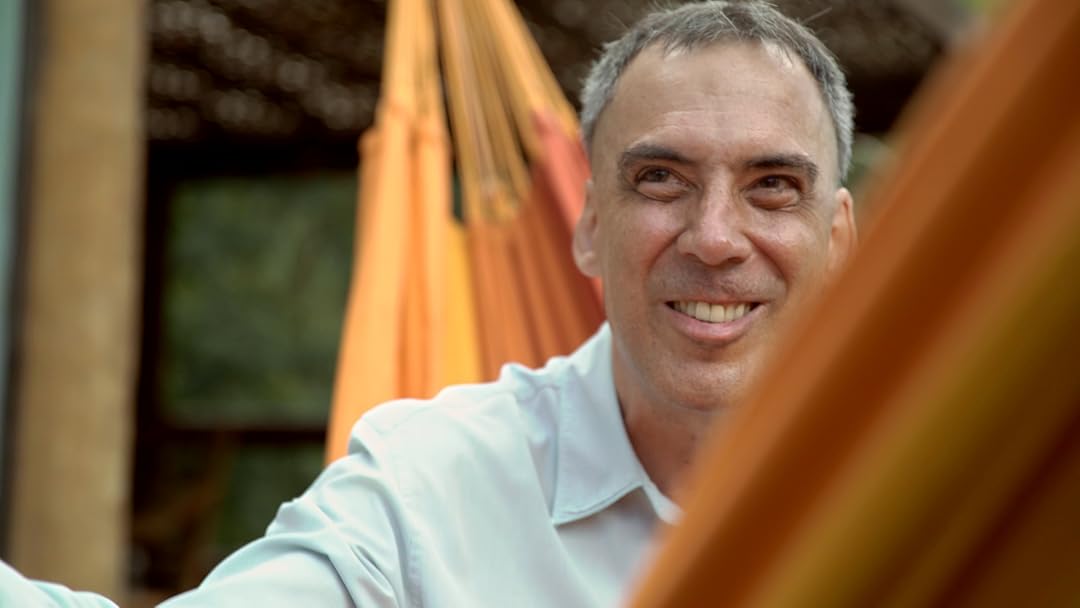
Musician, poet, and visual artist, Arnaldo Antunes, 64, is one of the leading figures of Brazilian urban culture. His most visible facet is undoubtedly that of a musician. He first came to prominence as a founding member of Titãs, the band that helped define Brazilian rock from the 1980s onwards, with songs such as Polícia, Pulso, and Miséria.
He later embarked on a solo career in which language has always played a central role. Along the way came the enormous success of Tribalistas, the project that united him with Marisa Monte and Carlinhos Brown for two albums and numerous performances.
Throughout this period, he simultaneously developed a career as a poet, publishing several books—carefully designed by himself—with a marked inclination towards visual poetry, though always keeping the word as the fundamental element.
Quase Tudo (Almost Everything), published in the Plural collection of Imprensa Nacional/Casa da Moeda and edited by Jorge Reis Sá, gathers his poetic work. Alongside the words themselves, Antunes has transferred the graphic language of each original volume into this new object.
At the same time, the musician—honoured this year at Escritaria in Penafiel—is touring with the live version of Lágrimas no Mar (Tears in the Sea), in partnership with the young pianist Vítor Araújo. Always searching, as one of his best-known songs puts it, for “something that can be felt.”
The Bible says that in the beginning was the Word. In your case, what came first: words or music?
Arnaldo Antunes: They arrived together. At the same time I became interested in poetry, I was taking guitar lessons and wanted to compose. My adolescence was shaped by the convergence of poetry and popular music. Brazil has a tradition of sophisticated popular music as sung poetry.
It was also the period when Tropicália met concrete poetry. There were poets who also wrote songs, such as Vinicius de Moraes, Torquato Neto, Waly Salomão, Paulo Leminski, and António Cícero, whom we recently lost. Visual poetry and song emerged together for me, both driven by a fascination with words—whether sung or connected to graphic materiality.
When you have an idea for a poem, how do you know whether it will become a poem or a song lyric?
Usually I already have an intuition of its destination while writing it. But exceptions have become increasingly common. Some poems I wrote were later set to music by others, while some song lyrics eventually acquired a visual form. There is a great deal of movement between these fields.
Although you are a musician, your poetry does not always privilege orality. Some texts only make sense on the page, especially because of their visual dimension.
Most of the poems published in books were created solely to be read. There is a form of writing intended for the page or for visual reading, in which I shape things graphically in order to create meaning.
There is a strong graphic concern in your books and poems. Is that a puzzle for publishers?
From the beginning I have designed my own books. In fact, I also created many album covers. My poetry is conceived with graphic materiality in mind. My first book, which is not included in this volume because it would have been impossible to reproduce, consisted of loose sheets inside a folder.
I’ve always been passionate about graphic design. This began before digital printing existed, so I followed the entire process—typesetting, film separations, negatives. You had to deliver the negatives and only saw the result a couple of days later. Today you just press a button and it’s done.
Technological evolution has enormously expanded the range of available resources. Computer-generated effects now create entirely new linguistic challenges.
Song lyrics were not included in this book. Why?
That would have required a different kind of book. I would like to create an anthology of song lyrics. I think it’s interesting because some lyrics acquire a new meaning when read rather than sung. But this volume brings together all the poetry books I published in Brazil, something that had never been done before. Nome and ET Eu Tu are not included in their entirety because of graphic constraints. The others are there, adapted from their original designs, which was both a lot of work and a great pleasure.
But in some sense they belong to the same material?
Yes. I often perform poetry at festivals, using poems that have a sonic dimension. One of my books even included a CD with sound versions of the poems. I’ve always done that largely on my own. It’s something musical, but not quite song. This show with Vítor Araújo is the first time I’ve brought both things together in a single performance.
Is the essence always the word?
Words in poetry are different from words in everyday use. In most activities, words possess a certain transparency; they merely point towards what is being described. In poetry, words seem to create an opacity. They turn into the very thing they point to. They are not simply describing something but becoming what is being said, as a linguistic experience. Instead of mediating our relationship with the objects of the world, they create a more direct path to the world by embodying meaning physically.
There is also a playful dimension to all this.
My creative process is very material. I produce many versions, print them out, make notes, return to the computer. It’s a process of distillation. Sometimes I write a lot and then extract just a small fragment, which becomes something entirely different.
Poetic creation begins with an idea, a spark, but through the creative process I often arrive at an idea that is different and more interesting than the one I started with. Composing music is the same. I record multiple melodic paths until I discover the one that best serves the lyric.
It is a highly material and playful exercise. I enjoy exploring the limits of language, subverting grammar in order to create a new aesthetic perception.
Always in dialogue with other arts. Some books include photography or illustration.
I always feel like an intruder. What I do is not visual art but visual poetry. What I do is not instrumental music but sung words. Poetry is always behind everything. Yet the desire to renew language leads me towards different supports, materials, and scales.
That is why I naturally gravitate towards the art world. Right now there is an exhibition of my sketches at the Museum of Contemporary Art in São Paulo. A few years ago I created a travelling exhibition that included videos, objects, and installations. I enjoy venturing into other languages.
This also reflects the times we live in. The same device now contains music, photography, drawing, animation, and video.
Returning to books: many of them seem to have a central concept. Is that established beforehand or discovered afterwards?
It’s difficult to begin with a concept. In some cases, I started writing with a specific idea in mind. That happened with As Coisas (Things). I began writing texts that approached the world with a sense of discovery, as if compiling an inventory of things through an original language that attempted to see them from an unusual angle.
Then I asked my three-year-old daughter to illustrate it.
But generally speaking, I am always scribbling, producing things, carrying a notebook and writing down ideas. When I feel I have enough material to imagine the seed of a future book, I begin organising it and developing the graphic project. Often I create many new poems in response to the existing group. That process brings cohesion to the book. It remains a very living process.
What does it feel like to see everything compiled in such a large volume?
It’s deeply gratifying. It provides a panoramic view of my trajectory. My first book dates from 1986. There was nothing I felt should be excluded. And I like being able to reproduce the original designs faithfully. Each graphic project has its own idea.
Did you feel tempted to write something new for the volume?
If I had included unpublished work, it would have become a different project. We didn’t have enough time.
Or to rewrite older poems?
No. I only feel like rewriting while I’m still working on something. Once it’s published, it no longer belongs to me.
In music, you started with rock and with Titãs, which challenged the notion that rock is too noisy to care about words.
I’ve always treated lyrics with the same care, whether writing rock and roll or a lullaby. That responsibility comes from the sophisticated tradition of Brazilian popular song. I always try to do my best, though language must adapt to context.
In rock, there were things I wrote specifically to be shouted. There are also songs I sing with the softness of a lullaby. Whether shouted or whispered, the same attention remains: the precision of the lyric, its relationship to what is being expressed, the rhythmic division of syllables.
Music often gives enormous power to things that seem banal on the page. Appropriateness is essential. A beautiful poem adapted badly becomes a mediocre song.
Did your solo career broaden your possibilities?
Yes. I left Titãs partly for that reason, so I could explore aspects of my creativity that would not fit within the band’s collective consensus. I was in Titãs from 1982 to 1992. Then came my solo career and later Tribalistas, with two albums. There have been several phases in my career, allowing me to sing in different vocal registers, experiment with diverse musical accompaniments, and move between genres.
Your latest album, Lágrimas no Mar, performed live with pianist Vítor Araújo, is quite surprising. Where did the idea come from?
It emerged from an earlier album already focused on strings and piano. I wanted to radicalise that approach and create a show accompanied solely by piano. It was initially meant to be the live version of O Real Resiste. I invited Vítor, we rehearsed, and then the pandemic arrived before we could perform it.
Instead, we went into the studio and recorded the album, which is now reaching the end of its tour. The collaboration revealed many shared sensibilities. Vítor comes from instrumental music but has an extraordinary sensitivity for supporting sung language. It’s a revelation.
And your next album of original material? What can you tell us?
It’s still germinating, but it should be ready by March.
On your previous album, O Real Resiste, there was a strong political dimension. How do you look at the world today, given recent events? Is there any optimism left?
It’s difficult to be optimistic. We are living in a dystopian world, with the rise of this stupid, fascist far right. I made O Real Resiste when Bolsonaro was elected. Yet everything remains very difficult.
We see humanity moving towards collective suicide through global warming, while those responsible do nothing to stop a process whose symptoms are already evident. What more is needed before the necessary measures are taken? What kind of awareness is still so difficult to achieve collectively?
At the same time, there is the global advance of neo-fascism, with increasingly isolated individuals becoming vulnerable to manipulation through social media. It is a profoundly dystopian vision.
Yet we must continue to cultivate what is good: culture, music, art, literature. All of this is more necessary than ever as a counterweight to this accelerated, violent, and destructive rhythm.