
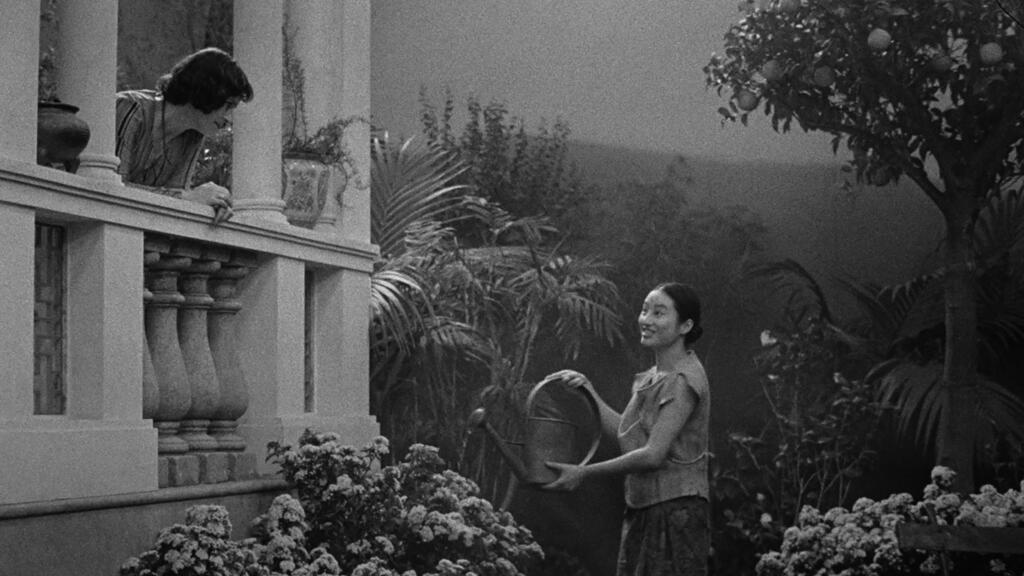
Based on a short story by Somerset Maugham and starring Crista Alfaiate and Gonçalo Waddington, Grand Tour takes us on a journey across Asia in pursuit of its two protagonists: a man on the run and the fiancée who follows him.
For this fiction feature, Miguel Gomes created a kind of contemporary archive, intertwining fiction with documentary footage from each of the places through which the story passes. The film is spoken in Portuguese and narrated in various Asian languages.
Miguel Gomes is one of the most acclaimed Portuguese filmmakers working today. He began his career in 1999 with the short film Meanwhile. His body of work includes, among others, Our Beloved Month of August (2008), Tabu (2012), Arabian Nights (2015), and The Tsugua Diaries (2021, co-directed with Maureen Fazendeiro).
You have filmed in Africa, you have a project in Brazil, and now Asia. Is the idea to travel around the world through films?
Miguel Gomes: I also have another project set in Brittany… But I’m beginning to realise that, for me, making films is connected with the desire to depart, preferably on an adventure—an adventure as adventurous as possible. There is a clear separation between my everyday life and the idea of making a film.
Does that even apply to Our Beloved Month of August, despite it being filmed in Portugal?
In that case, it meant travelling into a particular territory within Portugal, one with its own rituals and rules. My task was to uncover them and reveal them through the film. You don’t need to travel thousands of kilometres in order to depart. But in the case of Grand Tour, there really were thousands of kilometres involved—not only because of the distance from Portugal, but also because of the journey undertaken within the film itself.
At the same time, while relocating your films to places you do not fully know, there remains a cinematic language that unites your work. How does that happen?
You could call it my nervous system, which includes my sensibility, my sense of humour, and my areas of interest. All of that remains active whether I am in Asia, Brazil, or Europe. Every place offers opportunities for wonder, for capturing things that speak to me because they are funny, beautiful, or moving. I don’t believe one territory has a greater capacity to seduce me than another.
Is your cinema a cinema of seduction and wonder?
I’m not part of the family of filmmakers who want to tell people things. I don’t want to talk. I want to see, film, and show. Wonder comes from never fully understanding why, in the Philippines, there is a national sport called karaoke and why My Way is its central object. I have no idea why. I simply encounter the phenomenon and try to capture it. It’s not my role to explain these things; I merely share my un-rationalised fascination with them.
You also don’t belong to the family of filmmakers obsessed with reality. It’s not that important to know whether that river can actually be navigated upstream…
Indeed, the river could not be navigated. But we never hesitate to include elements that depart from reality if doing so makes that parallel world we call cinema more interesting.
At the same time, there is a narrative dynamic in the film in which a more documentary layer seems to emotionally illustrate the fiction.
I always like trying to do one thing and its opposite. I’m a believer in that dialectic. I wanted to create narrative and editing mechanisms through a continuous flow in which, even when the characters are absent, they somehow remain present. The very nature of the project is discontinuous. We move from studio images evoking 1918 to footage featuring mobile phones and motorbikes from our own era.
I find it fascinating to observe how audiences respond. Some perceive continuity, never losing sight of Edward and Molly; others react positively or negatively to the discontinuity, seeing two different worlds succeeding one another despite the fact that the same story is always unfolding. We use archival images not from the past but from the future—the future of those characters. Yet we still try to keep the characters alive. Making a film is always difficult: you try to get things right and see whether they work. But for me, the idea of making two films in one is irresistible.
It’s not the first time you’ve done that…
Looking back, I think my films are always the result of a pre-defined process, though that process may take very different forms. In Arabian Nights, for example, the idea was to create fiction out of current events without being able to anticipate anything and without a pre-existing screenplay. We had to write on top of reality and film as quickly as possible. In The Tsugua Diaries, we all entered a house for an artistic confinement. The only thing we knew was that we would make a diary of that moment, reversing its pages. Everything else we wanted to discover while doing it.
And in the case of Grand Tour?
I took the story from two pages by Somerset Maugham. It contained the itinerary and the joke that women are stubborn and men are cowards. I told the producer that before anything else I wanted to film the journey itself, creating a kind of archive that would later become part of the film. So I travelled not only with the screenwriters but also with the cinematographers and sound recordists. Back in Lisbon, we set about manufacturing fiction from those images.
The film is divided into two parts. This idea of chapters and sections, often marked by intertitles, is common in your cinema. What interests you about that?
I’m fascinated by the existence of a visible structure that seems to define the rules of the game. As a viewer, I enjoy entering a film and seeing how it works, because films do not all have to function in the same way. Once a model has been established—and not concealed—variations begin to emerge within what appears to be a highly normative framework.
It reminds me of Alain Resnais. He created worlds governed by very clear rules and openly displayed them. Think of Smoking / No Smoking, which continually branches into different possibilities, or Same Old Song, in which characters suddenly begin singing playback versions of French chanson standards. He would throw the film’s mechanics in the viewer’s face, yet the result remained surprisingly free despite being so carefully pre-structured.
In Grand Tour, there is a dialogue between documentary reality and studio construction. We wanted to explore what kind of dialectic could emerge from those constant transitions.
The main characters are English, yet they speak Portuguese. Couldn’t this have been an opportunity to reach new markets by making an English-language film, as some European directors have done? Did you ever consider it?
There was some pressure from co-producers in that direction, hoping for a more commercial approach involving American or British actors. So I made the decision that everything in the film would be spoken except English.
In a sense, it is a way of reversing cultural dominance and linguistic imperialism. Although I have no problem with such things because I embrace the artificiality of cinema. Many decisions are tied to the economic systems of production in different countries. If Americans film Ancient Rome with everyone speaking in a Bronx accent, that is not a problem for me. Likewise, when I watch a Chekhov play, I do not believe its truth depends on being performed in Russian. The truth of a work lies in a world governed by its own conventions—in this case, one where British characters become Portuguese.
Even so, let me rephrase the question. Many European directors eventually give in to the market and make films in English. After winning a prize in Cannes, don’t you feel that temptation?
I could answer more easily if such an offer had ever appeared. And I suspect it never will. The prize in Cannes is important and will certainly expose my work to a wider audience. But what I do is too singular, perhaps too eccentric, to fit comfortably within industrial systems. No one expects me to behave myself.
I don’t see that kind of invitation on the horizon. They will always assume that I am incapable of making a film designed to please a mass audience. Then again, what do I know? Perhaps in a few years I’ll be directing The Lord of the Rings 20. Nobody can predict the future.
The Guardian described your film as sophisticated, innocent, and charming all at once. That’s a difficult combination. How do you preserve innocence within sophistication?
It comes from wonder, from the ability to look at something and say “wow”. Nowadays it’s becoming harder and harder to say “wow” because the world has been deciphered, explored, commercialised, and packaged in such a way that nobody spends much time discovering it anymore. The image of the traveller encountering something completely unexpected is slowly disappearing. The world now arrives pre-packaged, like fast food.
At the end of Grand Tour, there is once again a gesture of deconstructing cinema, of revealing the machinery behind it. Is that a signature of yours?
The film was always a film from the beginning. It’s not a matter of metacinema. Film characters are puppets, fictional beings, entirely false, yet they can help us connect with our real lives, with ourselves, and with the future. Falsehood is one way of accessing truth.
Is that why there are so many puppet scenes in the film?
Puppets are immortal. They can always stand up again, but they will never become part of life. Edward and Molly, however strongly viewers connect with them, remain puppets. I’m not interested in character psychology; I’m interested in the spectator. From very early on, it is established that these characters are creations of both Western and Asian culture.
They are characters driven by obsessions—one by flight, the other by pursuit…
That’s the starting point: two characters in motion, almost in opposition. Edward is introverted, hiding from the world, which is why his screen time is considerably shorter. Molly, on the other hand, performs a kind of takeover of the world according to her desires and objectives.
But I’m not entirely sure what goes on inside the characters’ heads. Gonçalo Waddington taught me a lesson in Cannes. I see Edward as a coward, but Gonçalo told me he never played him that way.
One of Molly’s defining traits is her laugh. Where did that come from?
It was one of the most absurd days of my life. We spent hours trying to invent different laughs. It was Crista’s first day of work. When we finally found it, we were so pleased that we did nothing else. We knew it would be crucial to the character.
Do you still work with the so-called “central committee”?
That began with Tabu. We had financial problems and were forced to rethink the film while shooting it. We didn’t want to make a poorer version of the project; instead, we looked for scenes that could provide what interested us despite our lack of resources. The idea became writing while filming.
This time, the process involved reacting to what we had filmed in Asia and then returning to the writing during editing. These are very organic processes in which writing, preparation, shooting, and editing constantly overlap.
Did you have fun making this film as well?
Sometimes it seems as though we had more fun than we actually did, because there are always moments when everything appears on the verge of collapse.
The decisive film for everything I later did was Our Beloved Month of August. We began with a conventional screenplay, but everything fell apart. So we simply went to the Beira region and filmed whatever seemed interesting. It was the happiest shoot of my life.
At that moment I realised something could happen if films followed a logic of pleasure and discovery, without knowing the day before what we would film. That principle has remained with me ever since.
Perhaps today I seek production models that allow such moments to exist. With Grand Tour, there was the pleasure of travel. At the beginning of 2020, we travelled through all those countries except China because, the day before, the ferry connecting Japan and Shanghai was cancelled due to Covid. We arrived back in Lisbon with eighty per cent of the footage shot. Then suddenly we entered lockdown—the exact opposite of all those kilometres travelled.
Yet I also found it fascinating to go into a studio and create a world from there.
What will your next project be? Will it finally be Selvajaria?
Yes. It’s an adaptation of Os Sertões by Euclides da Cunha. In 2018, I went through the most difficult period of my professional life. I had never worked so hard on a screenplay and travelled repeatedly to Brazil, yet the project seemed like an impossible mountain to climb.
Grand Tour reopened those possibilities. We are now quite optimistic. Back then, Luís Urbano and I were preparing Selvajaria, but there was no public funding available in Brazil. That has now changed.
Was it primarily a budgetary problem?
Yes, and then Covid arrived. At one point we had substantial funding, but every grant came with an expiry date. Eventually several sources of support were about to lapse, and the producer felt the project could not move forward without the Brazilian component.
Now I am returning to it with Filipa Reis, and I feel optimistic. If everything goes according to plan, we will begin shooting in late 2025 or early 2026.