
In one of the film’s (Shape of Momo, 2025, directed by Tribeny Rai) early scenes, the protagonist Bishnu’s mother reprimands a migrant labourer who sneaks onto the family’s premises late at night to fetch clean water for cooking. She scolds him for trespassing, fearing that he might wake Bishnu’s father, who is asleep. There is a catch: the father has been dead for years.
The omnipresence of Bishnu’s father long after his demise reminded me of a conversation I had with my friend and, at times, obnoxious film critic Virat Nehru after watching Payal Kapadia’s All We Imagine as Light (2024). He remarked that “the film shows how the seemingly invisible men continue to control women’s lives, their movements and their desires,” referring to Prabha’s absent husband in Kapadia’s Cannes Grand Prix-winning feature.
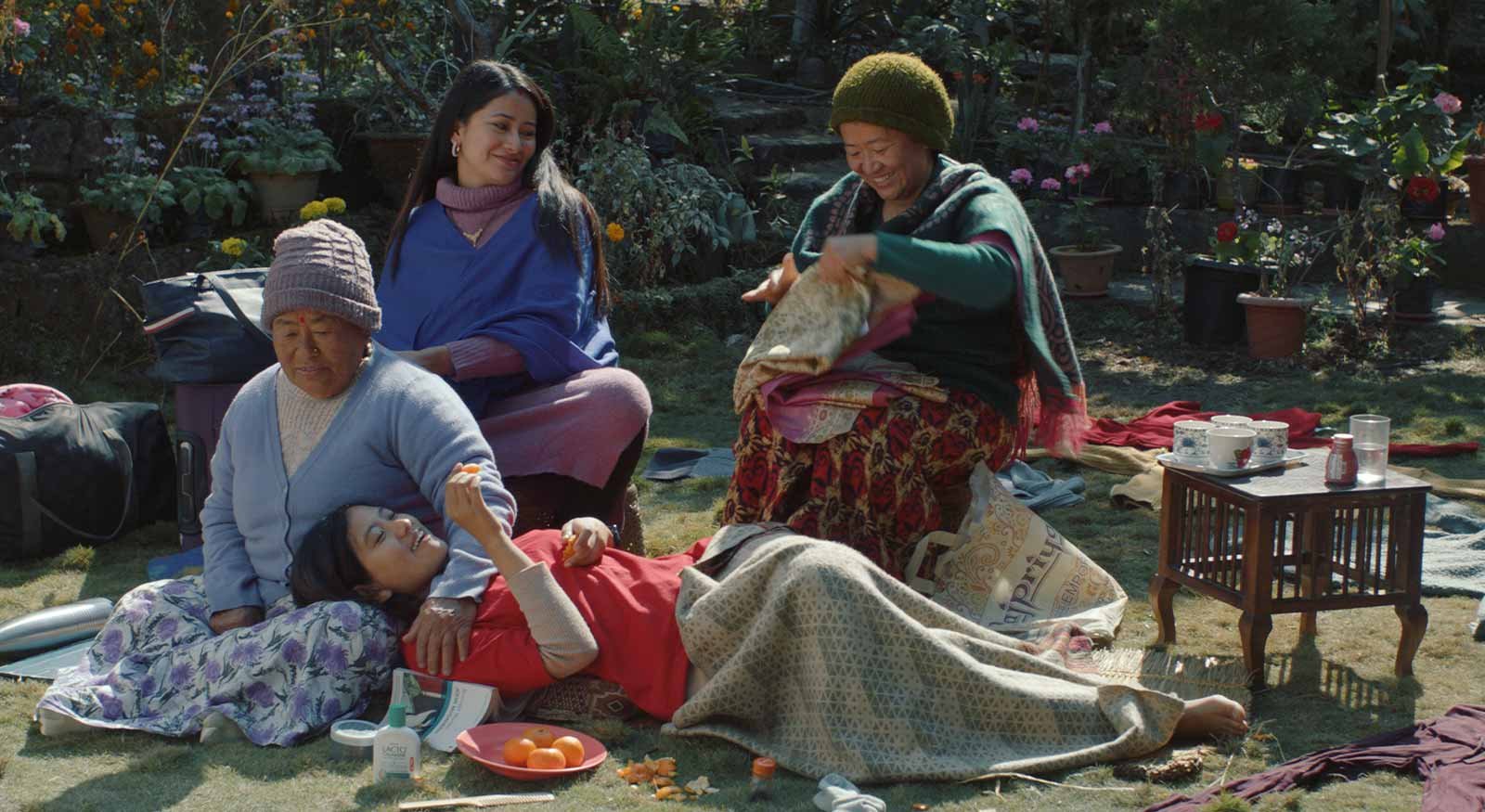
In Shape of Momo, we see Bishnu’s absent father’s presence throughout the film, including in the old clothes hanging on a rope outside the front door, serving as a symbol of protection for a household of four women: Bishnu, her mother, her grandmother and her married sister, who has come to stay for a few days. Bishnu’s uncle, living in Dubai, is another absent male member of the family, sending gifts from afar but never showing up to care for his ailing mother.
In one scene, he sends a dolphin-shaped massager for his mother, which reminded me of yet another parallel with Kapadia’s film. In All We Imagine as Light, Prabha hugs an electric rice cooker in the middle of the night, a presumed gift sent by her husband, whom she has not seen for years.
Growing up in a household devoid of male members, Chhora Jastai (which translates as “Like a Son”, and is also the film’s original Nepali-language title), I understand Bishnu’s frustration at seeing her mother and sister leaning on male figures for support, even when it appears necessary. Having lived a large part of my adult life independently, without a male presence, the frustration feels personal.
The constant negotiation between empowerment and vigilance is the lived reality of women across India, regardless of geography or the urban-rural divide. Construction workers and labourers want to speak to the man of the house; vegetable vendors refer to you as bhabhi (sister-in-law), even when there is no bhaiya (brother-in-law) in sight; neighbours and landlords feel entitled to scrutinise who comes in and out of your home.
Where the film succeeds most is in its nuanced understanding of how female agency is undermined. It is not stripped away through some caricatured act of villainy that is easy to denounce. Rather, it is eroded gradually through everyday microaggressions that accumulate over time.
For example, when a blank caller repeatedly harasses Bishnu’s mother, she hands the phone to Bishnu’s prospective fiancé instead of to her own daughter. The scene struck a personal chord. How many times have I handed my phone to a male friend to scare off a harasser on the other end of the line? How many times have I invented an imaginary husband “waiting back at the hotel” to ward off unwanted advances while travelling alone?
A man respects another man’s claim over a woman more readily than he respects a woman asserting her own autonomy.
Director Tribeny Rai’s story may take place in Sikkim, far from where I live in Delhi, but it is the story of countless Indian women, whose worth is constantly measured against the value placed on their domesticity—whether shaping the perfect momo or rolling impossibly round rotis.
The beauty of Shape Of Momo lies in the way it depicts the complexities of class privilege within the narrative of gender, homecoming and migration.
Bishnu has quit her job in Delhi and moved to her hometown in Sikkim. She’s not a victim and holds a certain position of privilege in society, and yet, her struggle to fit into this world is real. Her suspicion towards the migrant labour working in her orchard, her sense of judgment towards her mother and sister for forgoing a chance at a better life, the angst against patriarchy and the stubbornness to refuse any form of male help, are actions that feel like they’re driven from Bishnu’s own insecurities. What makes this film refreshingly honest is that when it matters, Rai does not hesitate to turn Bishnu’s questioning gaze inwards.
The film’s visual language switches between reality and poetry. I can’t help but see hints of other recent films that have explored nuances of what it means to be a woman in contemporary India, such as Payal Kapadia’s All We Imagine as Light and Jeo Baby’s The Great Indian Kitchen (2021).
Sikkim is one of the most beautiful and biodiverse regions in India, and its beauty comes through in every frame, but it is never extractive. As Bishnu herself writes in a letter to her mother, the mountainous background is nothing but a ‘quiet performance rehearsing itself for the city-weary visitors.’
The film’s greatest success is that it is able to balance two seemingly conflicting and opposing feelings: Bishnu’s desire to escape the mountain life is exactly the life that the city people dream about and imagine as a reprieve from their daily drudgery.
Much like Bishnu’s final note to her mother, I left the film with a knot in my throat, with the acceptance that it’s not always a daughter’s duty, nor is it her responsibility, to liberate her mother from a life she may or may not have chosen for herself.