

IndieLisboa can serve as a useful barometer of the state of Portuguese cinema. Yet in an age of extreme cosmopolitanism, gentrification, global thinking, dissolving intellectual, spiritual, and physical borders, fluid populations, and increasingly inventive multinational funding structures, a question imposes itself: what criteria govern selection (or exclusion) for the National Competition? What makes a film Portuguese? The nationality of the production company? The director? A ratio of Portuguese cast and crew? The shooting location? The language? The subject matter? Perhaps a mixed criterion, akin to Portuguese music quotas on the radio?
Most Portuguese filmmakers would argue that there is no such thing as a Portuguese cinema, in the sense of a school or movement; only a disparate collection of individual wills and mismatched identities that happen to share the same country as a point of reference.
The purpose of this text is not to redefine IndieLisboa’s selection criteria—that is a matter that functions well enough as long as there is a rule. Rather, it seeks a pretext to explore the filiations of a newest Portuguese cinema, in search of that lost root, that school, that fragile sense of unity. This despite the fact that, in a globalised world, we are all inevitably influenced by global currents. Yet one should not underestimate the influence of the neighbour next door.
If there is no sufficiently coherent body of work to define a Portuguese cinema, there are, at the very least, schools, tendencies, and movements—some probably unintended—that nevertheless take shape.
Cochena, by Diogo Allen
One of the clearest examples is perhaps Terratreme. The production company also functions as a cooperative of filmmakers who, in a sense, have seized the means of production in order to make their own cinema. This collective mode of production has consequences for the films it generates and seems relatively conscious. It comes close, in fact, to being a school or movement. As with other schools and movements, one can identify common features—one can almost guess which films are Terratreme productions—despite the different voices of their directors. They have not produced a manifesto like Lars von Trier’s Dogme movement, but whether consciously or not, they come remarkably close in practice. There is indeed an aesthetic, sensory, and emotional proximity between the films of Pedro Pinho, Tiago Hespanha, and Susana Nobre. A very particular language of the real, drawn from border zones and spaces of uncertainty, one that appeals to festivals but does not fill cinemas. The question is whether this language is inevitable.
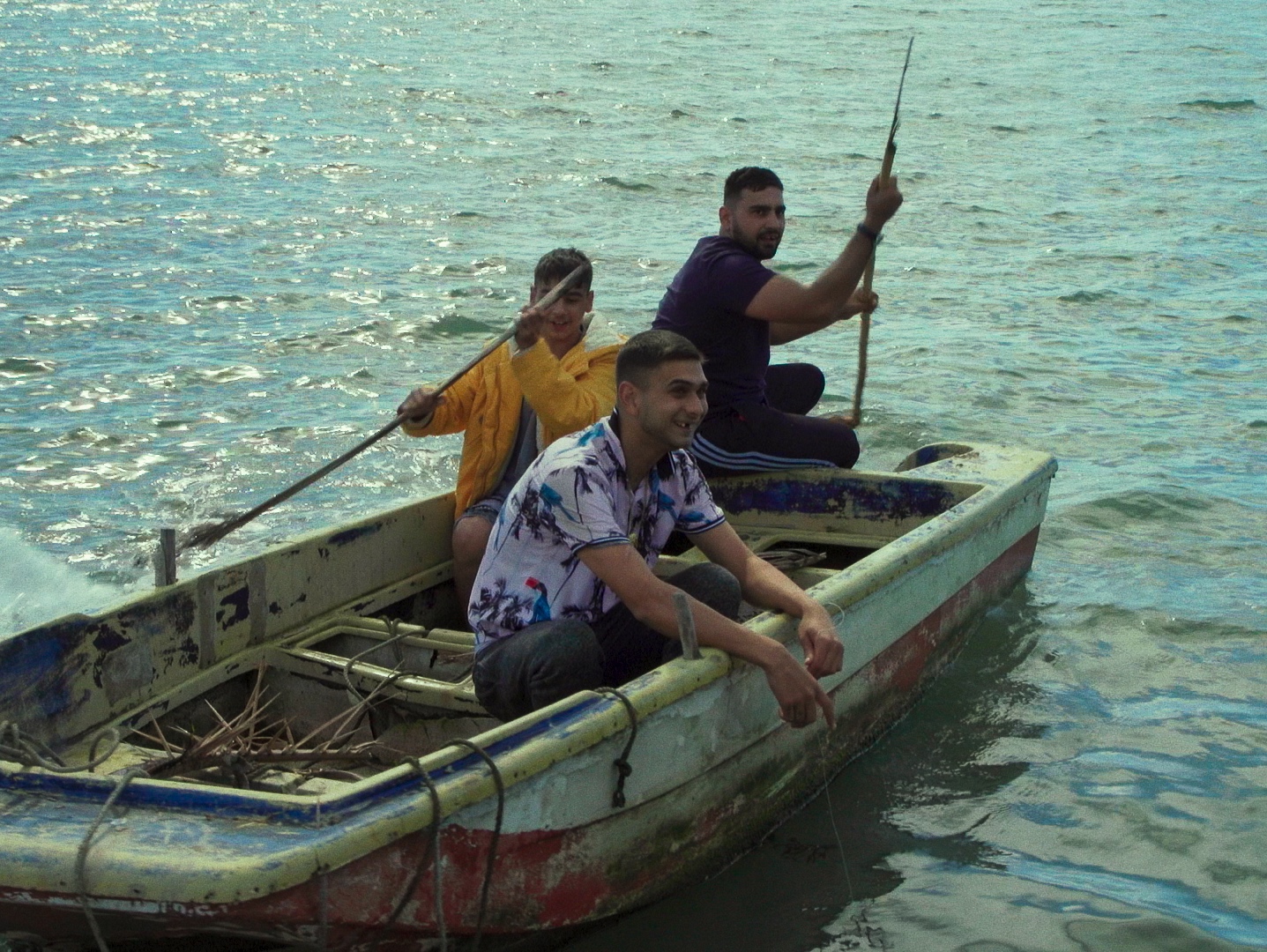
Cochena, Diogo Allen’s debut feature, belongs politically and ideologically to Terratreme’s sphere of action, yet formally and aesthetically distances itself in significant ways. Although it is a hybrid documentary, its zones of ambiguity and uncertainty occupy a different place from those found in the work of Pedro Pinho or Susana Nobre. Instead of a certain roughness in capturing the moment, leaving room for improvisation or accident, Allen’s film is immaculate—a kind of simulated perfection underscored by its digital 4:3 format. This self-imposed aesthetic limitation—probably linked to practical necessity—moves the film away from cinematic spectacle and the temptation to elevate its subjects through grand visual compositions.
In this respect it also differs from Leonor Teles’s Terra Franca, which might otherwise seem a natural point of reference. There is a similar commitment to prolonged observation, but not the same photographic rapture, even though the images and situations never feel crude or rudimentary. On the contrary, Allen’s hybridity, even more than Teles’s, stems from the fact that everything is so perfect and controlled that it becomes difficult to believe it has not been staged. If it is not exactly a mockumentary—like those featured in this year’s Indie focus section—it may perhaps be called a mock-fiction: a documentary filmed with such precision that it resembles fiction.
Its most fascinating and valuable aspect may be its political gesture. Allen films a Roma community in Ribatejo through the lives of an elderly couple. He films from within, creating a difficult web of complicity that can only be achieved through time: time before the film, time spent together, and an intrusive ethic that turns the camera into a mere circumstance. Watching the film, one does not feel like an outsider observing a Roma community, thereby dismantling prejudices. Rather, one feels, for an hour and a half, like a member of that community. That is as difficult to achieve as it is valuable.
Paradoxically, Allen’s political gesture is accomplished by moving away from politics. Social prejudice against Roma people is not addressed in a single scene. There is no testimony of conflict with the outside world, neither from within nor from without. It is a complete non-issue. Faced with social tension, the director seems to choose instead to show another side: a fragment of life, an idyll, and from there offer viewers the possibility of a detoxified perspective. Their existence cannot be defined solely through opposition to wider society.
What Allen ultimately proposes is a model of life. A desirable and enviable one, close in many ways to austere Christian and conservative ideals: a strong sense of community and family, a joy of living, a way of being that leaves room for work and leisure, family and friends, rest and the arts—especially music. Allen’s Roma community embodies a social utopia, a way of life worth pursuing. We should not expect them to integrate into our world of consumption and speed; perhaps it is we who should learn from them. Their lightness, now seen from up close, becomes both lesson and path toward happiness.
Kiss and Be Friends, by Ana Baldini and Roly Witherow
A paradigmatic case is Kiss and Be Friends, by Ana Baldini and Roly Witherow. The film is directed by a pair of filmmakers with foreign names, yet shot in Portugal and focused, in a very concrete and rather depressing way, on contemporary Lisbon. With some generosity, one might place it alongside films that bring Lisbon to the forefront from a generational perspective, reflecting the anxieties and consequences faced by a generation battered by gentrification. Examples include Leonor Teles’s Baan, Duarte Coimbra’s Love and Avenidas Novas, Frederico Serpa’s Arrabalde, and, more recently, João Rosas’s excellent A Vida Luminosa.
The difference lies in perspective. In A Vida Luminosa, there is an attempt to salvage what remains of the city, the crumbs left behind by gentrification, by someone who still has the privilege of living there. Little remains, but enough to make a joyful film.
In Kiss and Be Friends, the metaphor of gentrification is merciless. A Portuguese woman who emigrated to England returns to Lisbon accompanied by a French friend with whom she shares an ambiguously sexual relationship. Sofia is a foreigner in her own city. She possesses only vague references—a beach and a “Disney castle” in Sintra. She has no emotional roots left. It is a vast emptiness.
Armandine, the bullying friend travelling with her, appropriates the city far more aggressively. It is unsettling. They take taxis everywhere, ride tuk-tuks; all that is missing is a trip up the Santa Justa Lift and a serving of codfish cakes with Serra cheese. At a party, Armandine seduces a pseudo-artist by claiming she is setting up a gallery for emerging artists in England. In the process, she abandons the friend who brought her there and appropriates the city with astonishing arrogance. In the end, after using everyone and everything around her, she discards them and returns to her French ex-boyfriend living in England.
Whether the filmmakers are fully aware of it or not, what they reveal is perhaps the harshest perspective of all: that of the gentrifier, the one we prefer not to acknowledge. A city so transformed that even Portuguese people can no longer find roots in it, a city that imitates others and is taken over by foreigners—in this case, a French woman—who exploit both the city and its inhabitants, using money and false promises before moving on. At best, Baldini and Witherow knew exactly what they were doing when they created one of the most irritating and toxic characters in recent Portuguese cinema, which is generally more accustomed to dealing with morally ambiguous figures. Beyond that, the film possesses a fragile freshness born partly from its limitations.
Black Sunglasses, by Pedro Ramalhete
Pedro Ramalhete’s debut feature occupies neighbouring territory. Ramalhete was the screenwriter of Duarte Coimbra’s Love and Avenidas Novas. In Black Sunglasses, one finds a more clearly defined generational affinity, almost a movement: a group of friends emerging from the same film school, representing a generation with something urgent to say. It is close, though slightly offset in age, to the cinema of Pedro Cabeleira.
The film offers a harsh journey into the interstices of Portuguese cinema. It depicts a film industry too small to function as a true industry, yet behaving like one, complete with all its habits and affectations. It seeks humanity while often operating in deeply inhuman ways. Pedro studied screenwriting but ends up exploited as part of a production team. These behind-the-scenes glimpses of Portuguese cinema are not pleasant: pressure, bullying, conflict, delays and setbacks, populated by people consumed by self-importance. There is no space for creative or artistic value, however much Pedro tries to find it. It is far removed from the inspiring theatrical backstage world depicted in José Álvaro de Morais’s Zéfiro.
The world of cinema becomes the non-cinema, the worst of worlds. Yet the film contains an implicit denunciation, almost a collective wake-up call: let us reflect, let us reinvent the means of production.
This courageous and incisive work, built around a deceptive sense of lightness, contains a generational parable: those who dream of writing screenplays and end up serving coffee. It belongs to a broader group of films united by the same urgency of denunciation: the best-educated generation in history finds itself with no professional prospects. Within this dystopian portrait emerges a proposal for change, a demand for space, a generational cry from someone saying: we are here, clear the way, because we have things to say.
Note: also published in Buala