
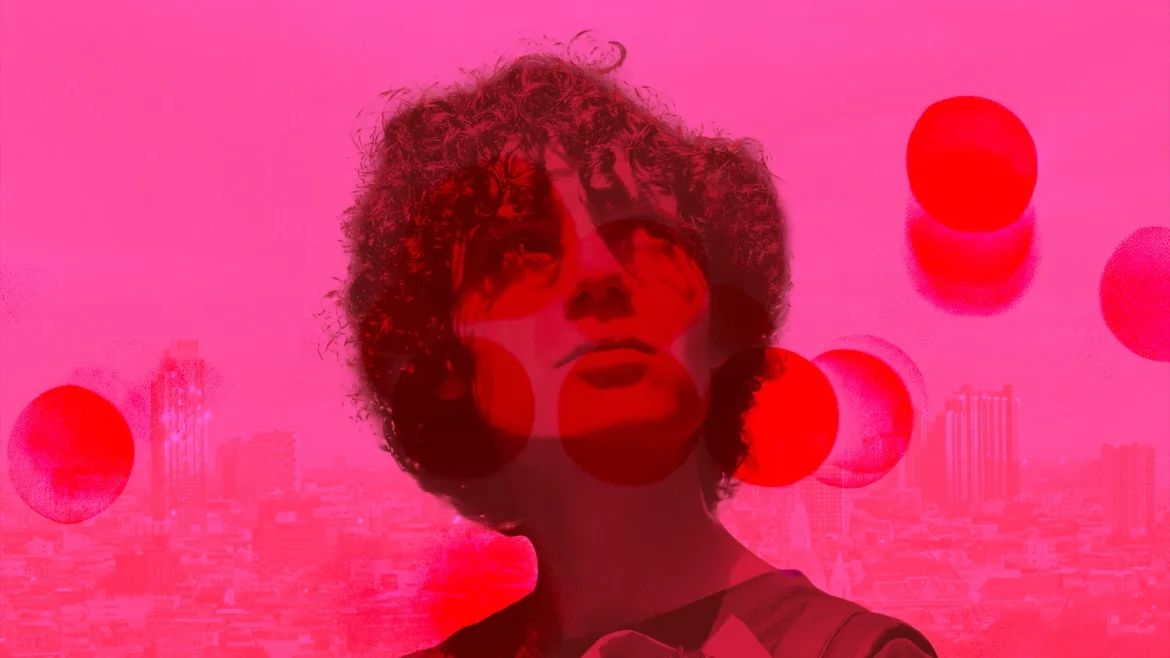
“The film is like a roller coaster. Just let yourselves be carried away,” Leonor Teles warned at the premiere of her first feature film. The only thing missing was a request to fasten our helmets. Baan is indeed vertiginous, and it benefits enormously from being seen in a cinema. There is a constant sense of movement and urban transformation, something the young filmmaker partly drew from the cinema of Wong Kar-wai. This is a film in motion.
As she herself explains: “There is one side of the film that is very carefully developed and constructed, but there is another that is highly intuitive, left to the whims of the wind. The character is always in motion, trying to escape her emotions, and I wanted the structure and editing to flow in the same way.”
The film’s movement conveys the state of mind of a character who feels disconnected both from herself and from the world, lacking both a physical and an emotional home, and forced to move endlessly in circles. El, played by newcomer Carolina Miragaia, who also composed part of the film’s soundtrack, is a young architect living in a shared flat in Lisbon, unable to settle either physically or emotionally. She experiences an intense love affair, but one that seems to be swallowed up by the city’s own constant process of becoming.
It is the portrait of a generation without shelter, in which every external constraint delays the resolution of the most basic emotional needs. The film carries a strong political dimension. Leonor Teles contextualises it: “We are living through very strange times. My generation faces situations that my parents never experienced. Instability has become the norm, and precarity is part of everyday life. We have jobs, but we don’t know how long they will last. People progress in their careers, yet still have to share flats. The suffocation comes from instability, from the lack of purpose, from wandering through life without knowing where to turn.”
Cinema of Intervention
Aesthetically, the starting point for Baan was the urban landscape of Asia, which fascinated Teles after a trip to Macau. Her original intention was to shoot the film there, but the restrictions caused by the pandemic forced her to change plans. The film ultimately unfolds between Lisbon and Bangkok, with the two cities overlapping into a shared and transnational urban identity.
This suffocating and globalised vision of the city is also embodied in the film’s co-protagonist, Kay, played by Canadian actress of Thai descent Meghna Lall. She symbolises the world itself and its broader crisis of identity and morality, its emotional dislocation.
Kay also provides Leonor Teles with an opportunity to address anti-Asian racism, a subject she has long been attentive to:“ Since the co-protagonist is Asian, I felt it was important to draw attention to this type of racism, which often remains hidden. There is a kind of cloud surrounding it because Asians may not be the group most visibly affected by racism, but they are still victims of it. And in Portugal they don’t really have a voice.”
Leonor Teles was born in Vila Franca de Xira in 1992. She has always openly embraced her Romani heritage, and her earliest films focused on that community. In Balada de um Batráquio (Batrachian’s Ballad), an authentically punk film, she can be seen entering commercial establishments and smashing the ceramic frogs displayed in shop windows—objects widely recognised as racist symbols directed at Roma people. The film earned her a Golden Bear at the Berlin Film Festival, a rare distinction for Portuguese cinema.
She later directed Terra Franca, a documentary set in Vila Franca de Xira, and the fiction short Dogs Barking at Birds, about gentrification in Porto. Along the way, she also worked as a cinematographer on films by other directors, receiving particular praise for her recent work on João Canijo’s diptych Bad Living / Living Bad.
Baan is now arriving in cinemas, and Leonor Teles still does not know what her next project will be. One thing, however, is certain: she intends to continue making politically engaged cinema.
“Cinema can be anything. And fortunately we live in a country that allows us that possibility. As for my own films, at least for now, I feel it is important to speak about these issues and reflect on them. If we don’t, things have a tendency to get worse.”