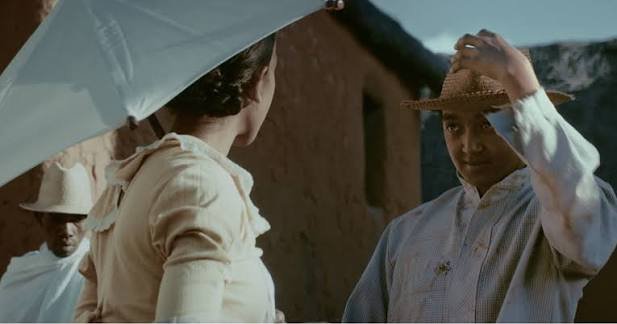



Chicas Tristes, by Fernanda Tovar, and Little Trouble Girls, by Urška Djukić: there is so much to unite them as to separate them and, perhaps for that reason, it is irresistible to propose a parallel reading of the two films.
First of all, they are the debut features of two promising directors, five years apart. Both already had a solid track record in short films and the like, and now venture into a first feature, gaining visibility at relevant festivals, with both having been awarded in Berlin (I saw Chicas Tristes at FEST, in Espinho). The two films cast a gaze on youth, on a generation that is no longer that of the directors (who are 35 and 40 years old), but which is still, in some way, accessible to them.
Female sexuality, in its best and worst forms, runs through both works, but with diametrically opposed perspectives, beginning with the context.
Little Trouble Girls takes place in the conservative setting of a church choir in deepest Slovenia. We are faced with a repressed sexuality that invites discovery through daring — between guessing games and the pursuit of pleasure, often already in the clear domain of eroticism.
Chicas Tristes is set in a sexually liberated Mexican youth culture that almost imposes sexual initiation as a desirable inevitability within the group logic. La Maestra, the most charming and determined character, even delivers a speech that overvalues sex, which enters into bitter contrast with the traumatic episode the film portrays.
The young people of Chicas Tristes are closer to those of Larry Clark and, even more so, to those of How to Have Sex, curiously also a debut film, by Molly Manning Walker, which follows the excesses of English students on a summer trip to Greece.
In Little Trouble Girls, sexuality is something forbidden, oppressed, codified, but always present. All of Lucia’s gestures carry an almost intuitive erotic or sexual intentionality. The film begins as an immersion in the sexual universe of this teenager, always in the domain of desire and temptation. The idea of sin sharpens desire.
There is an inversion of the classic paradigm: from a certain point on, the sexual objectification of the man becomes clear. And there is a prolongation of the tension and homosexual attraction — in the desire for the female friend, in the desire for the bricklayer’s body — with it left intentionally unclear which desire serves as a substitute for the other, or whether they are part of the same libido.
In Chicas Tristes, there is also, at first, a certain female emancipation in the idea of moral liberalism, in absolute contrast to Djukić’s film. The perception of the masculine claims a certain equality or even superiority also from a sexual point of view. This is also visible in the pool scenes, in which there is a very natural, not at all excessive, sensualization of bodies.
The pool in Chicas Tristes is the choir in Little Trouble Girls. A shared and supervised space where gazes and bodies intersect.
In both films there is a permanent and persistent homosexual tension. In Little Trouble Girls, this becomes more concrete, with the recent friend/colleague clearly becoming an object of desire, not escaping a group logic typical of morally oppressed communities that tends toward bullying.
In Chicas Tristes, the sexual tension also exists and is timidly verbalized, but is dissipated by circumstances and never comes close to materializing. What in Little Trouble Girls is an irresistible and irresponsible attraction, in Chicas Tristes, where (almost) everything is permitted, becomes a beautiful love story. A love story that, despite the tension, can legitimately be read as a beautiful story of friendship between two teenagers who dream of traveling together to Brazil.
This generational fluidity of Chicas Tristes is interrupted very early, in narrative terms, by a serious traumatic episode: Paula is raped by a potential boyfriend. This brings a distorted perspective to that world, almost sets it spinning in reverse. And it ends up not fitting into a simple coming-of-age film, but rather into a path of forced, unnatural, post-traumatic growth.
In Little Trouble Girls, the traumatic episode, near the end, is of a different nature: something approaching psychological harassment and serious psychological violence. A scene that is perhaps somewhat excessive, led by the choir conductor, but which precipitates the character into a self-destruction — or a self-configuration — that, if we wish, also forces her into that same forced growth. Otherwise, instead of a single trauma, Lucia’s world is made of this constant oppression, of games of affection and disaffection, with a tendency toward bullying.
Formally, the films follow distinct aesthetic schools that dialogue well with their respective contexts. Little Trouble Girls is more restrained and rigorous; Chicas Tristes gives the camera more freedom, letting it roam. Little Trouble Girls uses Sonic Youth’s music almost as the possible happy ending; Chicas Tristes invents a scene with mirrors on top of a Mexican building as a sign of hope.
Nevertheless, both films reveal some difficulties in constructing the ending, uncertain about how to exit. Both attempt something similar, tentatively promoting an idea of post-trauma rebirth, which is, after all, that idea of growth. One day they will be women.