

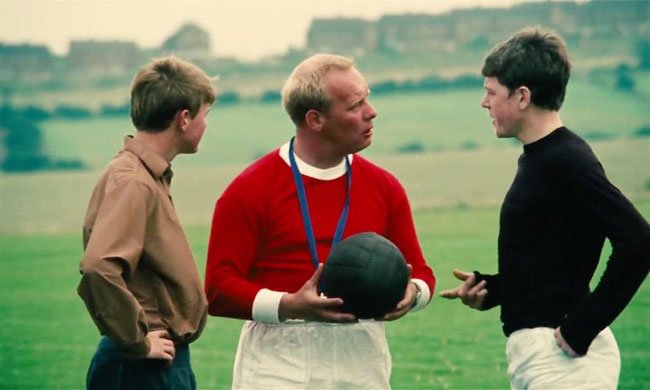

A memorable episode of a football match in cinema—especially when depicted by a director like Ken Loach—acquires significant symbolic and allegorical weight. In such instances, football transcends its primary essence as a sport. Depending on the author’s vision or the dramaturgical structure, a rare type of metanarrative emerges, transmitting information to the audience through specific symbolic codes.
In Ken Loach’s Kes (1969), the football match serves a pivotal compositional and thematic function within the narrative. Set in a working-class community in Northern England, the film contrasts the life of a young boy, Billy Casper, and his deep bond with a kestrel hawk against his harsh reality and strained relationships with adults—particularly educators and authority figures.
When Loach incorporates a football match, it serves a purpose far beyond mere entertainment. The match becomes a potent symbol for the perversion of authority, revealing the oppression of the younger generation by the older. The essential subject of the film’s reflection is the complex interaction between toxic, power-obsessed figures and the collective subordinate to them. Instead of fulfilling the moral and socio-political responsibilities assigned to them, these ruling figures oppress and marginalize their subordinates.
The privilege granted to these authority figures is presented as a form of reverse sublimation. The oppressor’s energy is redirected not toward socially valuable activities (such as nurturing a new generation) but toward the gratification of ego and control. Consciously or unconsciously, the teacher derives pleasure from dominating, punishing, and exercising total control over the children. Furthermore, beyond mere exploitation, these groups eradicate avenues for development. They attempt to compensate for their own past failures and unrealized dreams by crushing the new generation’s ability to dream.
The football episode exemplifies this discourse. It lays bare the vertical structure of power (coach, captain, players) and, through a psychoanalytic lens, exposes the coach’s attempt to satisfy his childhood fantasies through a simulation game. Before the match, he identifies his team as Manchester United and himself as the legendary Sir Bobby Charlton. This reveals the infantilism of the adult coach juxtaposed with his indifference toward social cohesion among the students. The apathy of the latter is a direct result of this violent teacher-student dynamic.
The cinematic image of the teacher is constructed entirely around an egocentric personality. He represents the collective face of an authoritarian ruling force that feeds its ego solely through harmful relations with subordinate groups. The football episode thus contemplates the nature of totalitarian control through an ambivalent prism, painting the teacher’s duplicity with meticulous precision. The tyrant teacher is simultaneously naive and sadistic: comical in one moment (the penalty episode) and horrifying in another (the locker room scene).
In the locker room, preparing for a pre-rigged game, the coach appears as an autocrat, physically abusing the children. During the game, tools of physical violence are supplemented by elements of ideological violence. As a result of his simulation, the coach awards himself a penalty kick. When he misses, he exploits his self-appointed status (acting as coach, referee, and captain simultaneously), lies, and retakes the penalty until he succeeds. Thus, Loach exposes a danger more subtle and insidious than physical abuse alone.
Allegorically, the stadium, surrounded by an industrial zone, is the material incarnation of a totalitarian state—a micromodel of the system. The coach plays the ruler, whose responsibility should be to foster an equal environment and share knowledge; instead, the children are cast as victims, robbed of any common good. The coach (the ruler) acts solely in his own interest, determining the rules, the refereeing, and the evaluation of the “game,” placing the children (citizens) in a perpetually disadvantageous position. The subject who should conduct the game according to objective rules is himself the lawmaker and the captain of one team, clearly illustrating the nature of totalitarian power.
This dynamic mirrors other institutions, such as the school and the family, where violence acquires an organized appearance. Individual violence evolves into a sophisticated, systemic form, taking root in society to construct a disciplined and repressive apparatus. This seemingly simple football episode thereby serves as an allegory for the violent history of the state against marginalized groups.
However, in the end, Loach offers a glimmer of optimism, allowing the viewer hope even in an unlikely situation: despite the rigged system and the tyranny of the coach, “Manchester United” still loses 1–2 to “Spurs”.