

"To be ignorant of what happened before you were born
is to remain forever a child." — Marcus Tullius Cicero
Head to any film festival showcasing Central Asian cinema, and you can entertain yourself with a private wager: try to guess how many of the films will be about a poor village, or a family still suffering from the Soviet collapse. Call it a rigged lottery — you’re guaranteed to win the bet.
To understand where this problem comes from, it helps to understand the mentality of Central Asia first. Here’s an example. In Uzbekistan there’s a joke: if someone opens a business, you can bet a relative or friend opened the exact same one recently. Having your own idea is always a risk, a road nobody’s tested. So people would rather not fix what isn’t broken, and just copy whoever went first.
The same principle tends to hold for a lot of filmmakers across the region too.
For audiences abroad, the same setting repeats itself over and over: a destitute post-Soviet village, a collapsed healthcare system, a close relative gone to find work elsewhere. For audiences at home, the approach shifts, but the formula is just as tired: a poor groom chasing a rich bride, a kelinchak — a young daughter-in-law — from a modest family, tormented by a harsh mother-in-law with money, and a dozen variations on the same conflict.
Look closely at the structure of these films, and you can see them working hard to disguise just how identical they are to the last one — like two peas in a pod.
To viewers — at home and far beyond the country’s borders — it might look like there’s simply nothing left to film. In reality, original ideas rarely even get a shot at being made, because producers, financiers and distributors want guarantees of an audience, whether in theaters or at festivals. And the only guarantee on offer is showing them, once again, whatever has already worked.
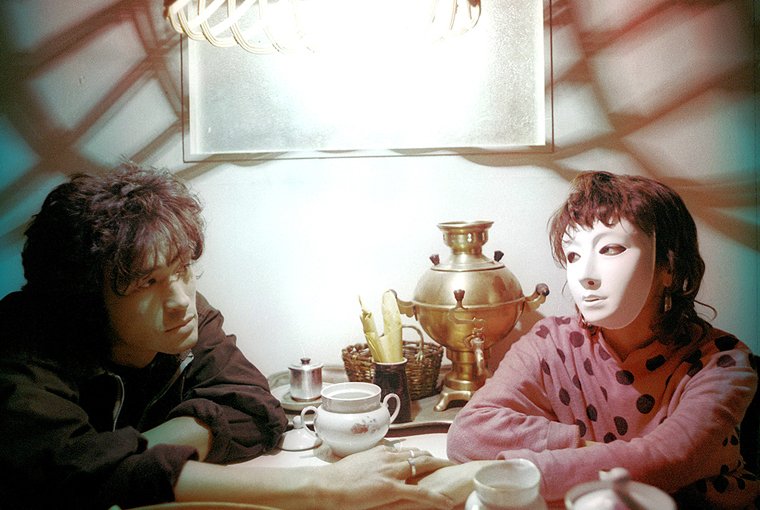
Between 1988 and 1989, a handful of young Kazakh directors caused a sensation in the West — Rashid Nugmanov with The Needle, and Serik Aprymov with The Last Stop, about drunkenness and decay in a Kazakh village. They were brought to Sundance under the banner “Wild Kazakh Boys,” and shown at the Moscow Film Festival as the “New Wave from Kazakhstan.” The success was, in a sense, predictable: for a full decade before that, filmmakers of the Iranian New Wave had been showing European audiences that same poverty, the same non-professional actors, the same half-ruined villages — winning over festival juries again and again with astonishment, and, right behind it, acclaim. Kazakhstan borrowed the formula in its own way, and caused its own sensation.
In other words, Kazakhstan may have taken the risk, but it was riding rails Iran had already laid down. And the rest of Central Asia, in turn, ended up taking its cues from Kazakhstan itself.
As a result, a seasoned viewer, seeing a Central Asian film set anywhere but a poor village, is already caught off guard — “huh, no familiar formula this time.” And it’s precisely how recognizable that formula has become, spottable a mile off, that keeps films built on it from being taken seriously.
What’s left to figure out is why the region produces so few bold voices telling something original. And this is where questions of, shall we say, self-definition enter the picture. Today we speak of “Uzbeks,” “Kyrgyz,” “Kazakhs,” “Turkmen” and “Tajiks” as the peoples of five independent Central Asian states. But the origins of these very names, and the lines drawn between these peoples, are artificial.
A century and a half ago, Tashkent, now the capital of Uzbekistan, was part of the Kokand Khanate. Bishkek, the capital of Kyrgyzstan, began as a Kokand fortress. And the land around what would become Almaty, once the capital of Kazakhstan, sat on the khanate’s northern frontier — Kokand collected tribute there, until Russia built a fort of its own specifically to put a stop to it.
The division of the peoples living across present-day Central Asia — Turkic and otherwise — into the five nationalities we recognize today happened with a stroke of a Soviet commission’s pen, in the first half of the twentieth century.
But while every nation in Central Asia wants to claim the history of past centuries as its own, the situation with the region’s most recent history is exactly the opposite. Every state in the region disowns the legacy of the Russian Empire and the Soviet Union, to varying degrees. And can you really blame them? Russian influence was heavy enough to split peoples apart, reshape culture, and reach into every internal process. The Soviet period is the most recent of all of it, and the most painful — tangled up with too much personal and family trauma.
And yet you can’t erase seventy years of history — more, in some territories — any more than you can delete your own parents from your biography. The region, in this sense, is exactly the child Cicero was talking about. Like a teenager who can’t strike his parents from his own story. He can be furious at them, but he still grew up in their house, still thinks in their language, still shapes his own ideas exactly the way they taught him to.
Like any more developed metropole, the USSR carried the latest technology, science, culture, and of course art, into its “colonies.” And it did so, naturally, in its own language: Russian. That’s exactly why, even today, thirty-five years after the Soviet collapse, at any local film festival you’ll find films shot in the local language, jury deliberations held in English, and everyone actually talking to each other in Russian. A huge share of teaching materials — including on the art of filmmaking — has still never been translated into local languages. And yet the region keeps methodically turning its back on Russian.
So here’s the bottom line — the hypothetical state of Central Asia: — films in its own language, but is forced to study in someone else’s; — tries to understand its own history, while avoiding entire decades of its own past; — takes pride in its masters — Ali Khamraev, Bakhtiyar Khudojnazarov, Jamshed Usmonov — yet avoids talking about them.
Here’s where that whole chain ends up. Tajikistan’s current Oscar submission, the film Melody, put forward for the 97th ceremony, was directed by an Iranian, Behrouz Sebt Rasoul. For its entry to the world’s biggest film award, the country had to borrow a director from its neighbors.
None of this means the region doesn’t know how to make films. The Kazakh horror film Dastur — its title means, roughly, “tradition” — outgrossed Hollywood’s Aquaman in local theaters. The Kyrgyz film Kurak played more than a dozen festivals and picked up a string of awards. The problem is that the region still can’t agree with itself on which past to remember — Soviet, khanate-era, Kokandi, or its own thirty years of post-Soviet history. And a niche is hard to build on a foundation nobody wants to talk about the origins of.
Central Asia is, of course, neither the first nor the last region to run into this problem. But as long as the industry keeps its eyes shut to such a large stretch of its own recent history, there will be no clear-eyed reckoning with that period — and without it, no real understanding of what makes each of these peoples distinct, of what that whole business of “cultural code” actually consists of.
And if you can’t understand yourself, how can you tell anyone else about you? Here’s hoping that in the years ahead, the region stops treating its Soviet-era history as something shameful, and studies it in full — finding, in the process, not just new ways to express itself, but a clearer sense of who it actually is.