

“How long can we remain passive in the face of injustice?” This is the question that could be addressed to Kwame (Parista Sambo), the protagonist of Disco Afrika: A Malagasy Story (2023, 80 min), the debut feature film by Malagasy filmmaker Luck Razanajaona, which has received recognition at several international film festivals. In the film, twenty-year-old Kwame works in illegal sapphire mines located on land that is about to be expropriated for the benefit of speculators. These speculators enjoy the support of a gendarmerie brigade that drives away local residents and sapphire miners. While Kwame escapes unharmed, his friend Rivo (Dominique Toditsara) is shot and killed during a nighttime raid. Kwame is then compelled to return his friend’s body to his family in the city of Toamasina, since, according to traditional Malagasy belief, a deceased person who is not buried in the land of their ancestors can never find peace.
Echoing this concern, Kwame also searches for the place where his father—arrested, tortured, and ultimately killed by the authorities following a protest—was buried. This quest exposes him to the poverty and corruption that plague his country.
A Panorama of Injustice in Madagascar
By closely following Kwame’s perspective throughout the film, viewers are confronted with the many forms of injustice he witnesses. From the outset, a radio bulletin mentions insecurity in the country, reporting that election assessors travelling to a polling station in Analalava, Ankazoabo, in the south of the island, have been murdered by dahalo—rural bandits. Later, another radio report discusses the trafficking of rosewood, a national resource from which a privileged minority profits illegally despite the environmental devastation it causes.
Youth unemployment is also portrayed: in one scene, Kwame returns home empty-handed after spending the day searching unsuccessfully for work, while his mother (Laurette Ramasinjanahary) encourages him. Even the issue of recurring power cuts is subtly addressed during a dinner conversation involving Kwame, his mother, and Babaa (Oza Jérôme), a photographer, musician, and friend of Kwame’s late father.
During this gathering, Kwame learns more about the circumstances surrounding his father’s death. Since he was only four years old at the time, he never truly knew him. Babaa also reveals that the name “Kwame” was chosen in reference to Kwame Nkrumah, Ghana’s first president, a major figure of Pan-Africanism and one of the key architects of the Organisation of African Unity, the precursor of today’s African Union.
Elsewhere, a puppet show alludes to Madagascar’s recurring political crises, specifically the disputed 2002 presidential election between incumbent Didier Ratsiraka and Antananarivo mayor Marc Ravalomanana. Finally, a street demonstration denounces abuses of power, electricity shortages, inflation, and the poor state of public infrastructure.
The cumulative effect of this panorama of injustices is to awaken both Kwame and the audience to the intolerable nature of the situation and the need for a collective awakening. Yet the film also leaves room for ambiguity regarding the protagonist’s true motivations.
The Ambiguities of Kwame’s Motivations
At the beginning of the film, Kwame is portrayed as a young man seeking personal gain through questionable means, mining sapphires illegally. His search for wealth amid mud and debris is symbolically illustrated through images of his shovel lifting wet earth. However, his departure from this world is not entirely the result of moral awakening. He is driven away by gendarmes acting on behalf of the speculators. Furthermore, he is consumed by guilt, believing himself responsible for Rivo’s death.
Later, while searching for work, Kwame reconnects with Idi (Joe Clarence Lerova), a childhood friend who has become wealthy through the illegal rosewood trade. Shortly afterwards, he is approached by Bezara (Drwina Razafimahaleo), the charismatic leader of a militant collective, who offers him a job as a dockworker in Toamasina. Yet this gesture is far from altruistic. Having witnessed Kwame’s encounter with Idi, Bezara sees him as the ideal person to infiltrate and sabotage Idi’s criminal activities.
When Kwame accepts the mission, his motives once again become unclear. Does he oppose rosewood trafficking on moral grounds? Or is he simply grateful to Bezara for helping him find employment and eager to integrate into his new environment?
This moral dilemma intensifies when Idi invites him to join his business ventures. Standing on a rooftop overlooking a street where sex workers wait for clients, Idi argues that one must be clever to escape poverty. Yet by then, Kwame is already acting as an informant for Bezara’s collective, reducing the tension between easy money and personal integrity.
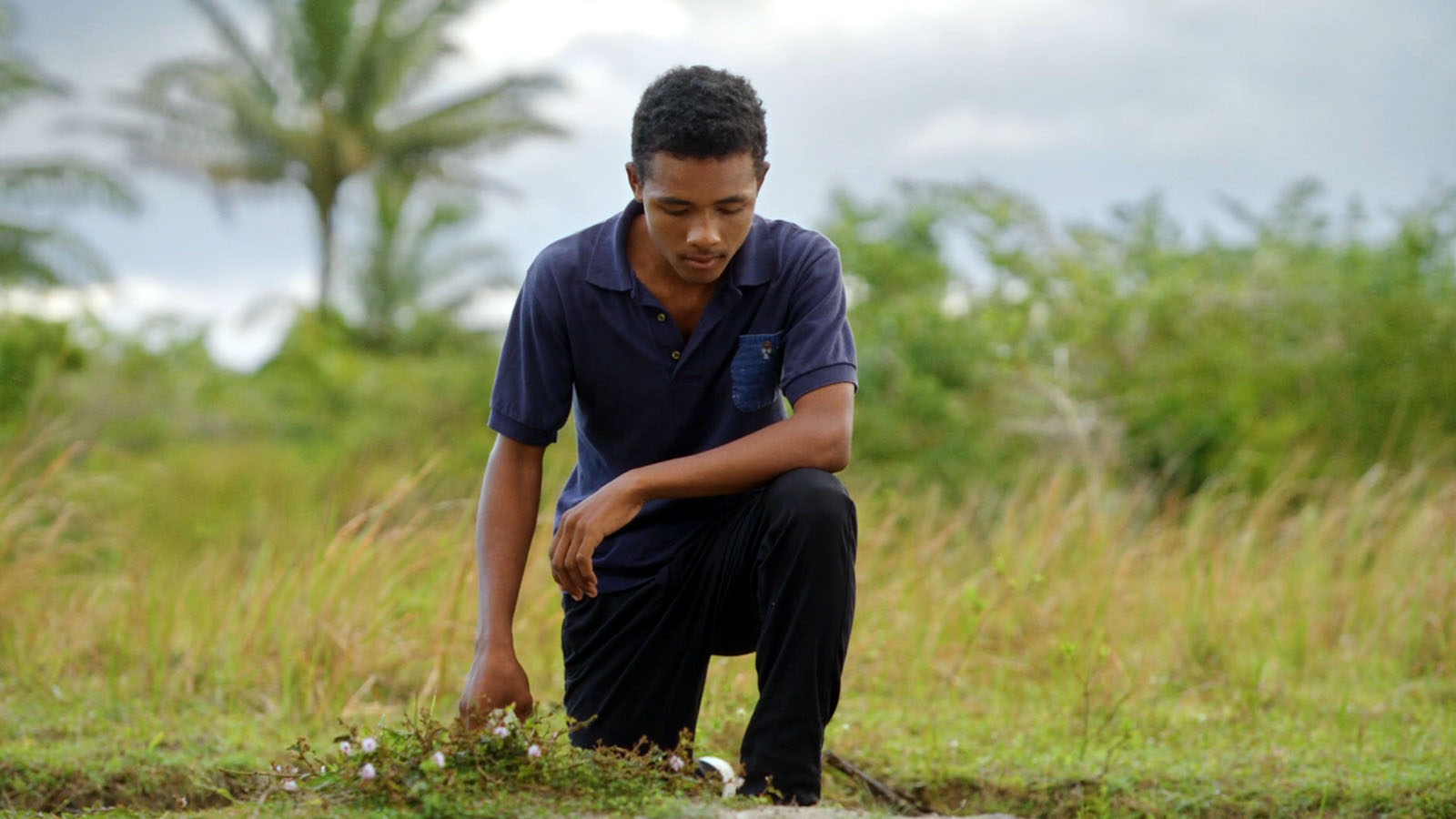
The situation becomes even more complex when Kwame discovers that Idi’s father betrayed his own father and was therefore implicated in his death. Moreover, Idi knows people who possess the map revealing the location of his father’s burial site. Eventually, Kwame finds the place and performs a brief ritual before saying, “Father, rest in peace.” Yet the site is a mass grave rather than an ancestral tomb. If one follows the traditional Malagasy belief established earlier in the film, this raises a troubling question: how can Kwame sincerely wish his father peace if he remains buried far from his ancestral land?
Near the end of the film, Kwame—now working as a tuk-tuk driver—addresses his country through a voice-over that signals his patriotic awakening: “After digging deep for so long, I searched for my path. I now know that your worth does not come from stones, but from the courageous souls who gave their blood for you. Madagascar, my country, I will strive to be worthy of you.”
Yet questions remain. What concrete actions will he take from this point forward? When exactly did this transformation occur? Was it through witnessing injustice? Through Babaa’s conviction that “to change things, one must dare to take risks”? Or was it through discovering his father’s burial site and deciding to carry on the cause for which he died?
The Central Role of Music
Music occupies a crucial place in Disco Afrika, particularly kaiamba, a genre that flourished during Madagascar’s disco years of the 1970s and 1980s. This choice is especially appropriate given that the story unfolds in Toamasina, regarded as one of the cradles of the genre.
Kwame’s arrival in the port city is accompanied by Dédé Fénérive’s Mbola ho avy. Babaa himself is played by Oza Jérôme, one of the major figures of kaiamba music. What begins as a simple visit to obtain a photograph for a job application becomes an opportunity for Kwame to discover the connection between Babaa and his father. He learns that both belonged to a group called Tout-Puissants Africa Voice, which performed politically engaged music advocating social change.
Babaa also gives him the only record ever recorded by his father—his sole tangible link to him. Eager to hear it, Kwame rushes home to find a record player and even invites his mother to dance with him to its instrumental melody.
The soundtrack remains consistently rooted in the culture of Madagascar’s eastern coast. Residents of a retirement home sing Ino maresaka Tamatave by Jean Kely and Basth, a song in the basesa genre that originated in the same region. The scene also humanises Idi, showing him bringing food and donations to the elderly rather than portraying him solely as a criminal opportunist.
Later, when Idi takes Kwame to the nightclub L’Afrika, the soundtrack features Tsinjaka Mpanambola, an Afrobeat song by Mad Max. The choice is technically anachronistic, since the story takes place in 2002 and the song is much more recent. Yet the decision seems deliberate, reflecting the filmmaker’s desire to maintain a strong connection between the music and the geographical setting, as Mad Max himself comes from Toamasina.
One might nevertheless wonder why no overtly protest-oriented songs appear in such a politically engaged film. Early in the film, Babaa performs Viavy Tsara, a romantic ballad addressed to a woman, despite his background as a militant musician.
Conclusion
With Disco Afrika, Luck Razanajaona delivers far more than a social drama. He offers a powerful portrait deeply rooted in contemporary Malagasy reality. If some ambiguity remains regarding Kwame’s motivations, it also reflects the contradictions of a generation confronted by systemic injustice. The film provides no easy solutions, but it raises an urgent question: how much longer must silent frustration endure before it transforms into collective action? And we, as spectators and as Malagasy citizens, how long can we remain passive in the face of injustice?
The film returned to the spotlight during the 2026 Cannes Film Festival, where it was nominated for the inaugural Build Your Dream Award, a distinction created by BYD, Mediawan, and Première magazine. Although it did not win, the nomination offered valuable international visibility to Malagasy cinema.
Note: This review was originally published in the 19th issue of Mozaïk, the international cultural magazine of the Indian Ocean (pp. 194–201), and has since been updated to incorporate the latest developments concerning the film. Crédits photos : We Film