

John Donne famously wrote that ‘No man is an island entire of itself,’ describing how every individual is involved in mankind. Each of us is a piece of the greater whole, which is the realisation the father of phenomenology made gradually. Edmund Husserl first developed this philosophical method in 1900, prompting people to focus entirely on subjective experience, later in his studies he acknowledged that intersubjectivity affects the perception of every single experience we have as individuals.
Alfred Hitchcock’s film from 1954, Rear Window, isn’t only a masterpiece of suspense, it brings forth perspectival perception. The film begins with a man who is a photojournalist and is confined to a wheelchair because of a broken leg. L. B. ‘Jeff’ Jefferies, played by James Stewart, brings his professional bias into what initially is an occupation to kill some time — while he is stuck in his cramped Manhattan apartment — and eventually becomes his method to spy on a neighbour who might have killed his wife. From his rear window, an entire world unfolds, that of more rear windows. Each neighbour has a different story to tell, but he observes them at a superficial level, according to the early Husserlian phase in which we bracket all our preassumptions through the epoché and focus on the object of our experience as it appears to us. Thusly, he decides to name the objects of his experience (his neighbours) according to how they appear to him. He observes a flamboyant dancer he nicknames ‘Miss Torso’; a single middle-aged woman who drinks he calls ‘Miss Lonelyhearts’; a talented, single, middle-aged composer-pianist; a couple who sleep on the fire escape on hot summer nights and who lower their small dog down into the courtyard in a basket; a sculptress often napping in her lounge chair; newlyweds who rarely raise the shades of their windows; and Lars Thorwald, a travelling jewellery salesman with a bedridden wife.
When we try to get to an essence of an experience, intentionality is involved. But the word itself should not be confused with the ordinary use of the word intentional, it should rather be taken as playing on the etymological roots from the Latin ‘intendere,’ which means to direct towards something. Thus, in phenomenology it refers to consciousness stretching out towards its object of thought, like an invisible string connecting the mind to the result of what is being perceived. Intentionality is often summed up as the ‘aboutness’ of that object of thought, because it is always directional and referential. Jeff begins his investigation in this manner: he enacts a subjective act, as he watches through his window, and draws his own conclusions of the seen-as-experienced. Edmund Husserl used the term noesis to describe the moment we experience things and noema as the result of that process.
Jeff fully embraces Edmund Husserl’s motto ‘Back To The Things Themselves,’ that is to say that we should return to how experiences appear to us, before imposing theories, assumptions or abstract systems upon them. Jeff enacts a forced phenomenological reduction, since what he is doing is observing his neighbours as an entomologist would watch a bug under glass. He is transformed into a spectator who can see what we ordinarily do not see in our active absorption of the world. However, analysing the object of his experience — relying entirely on his personal judgement and shutting out other perspectives — might be counterproductive.
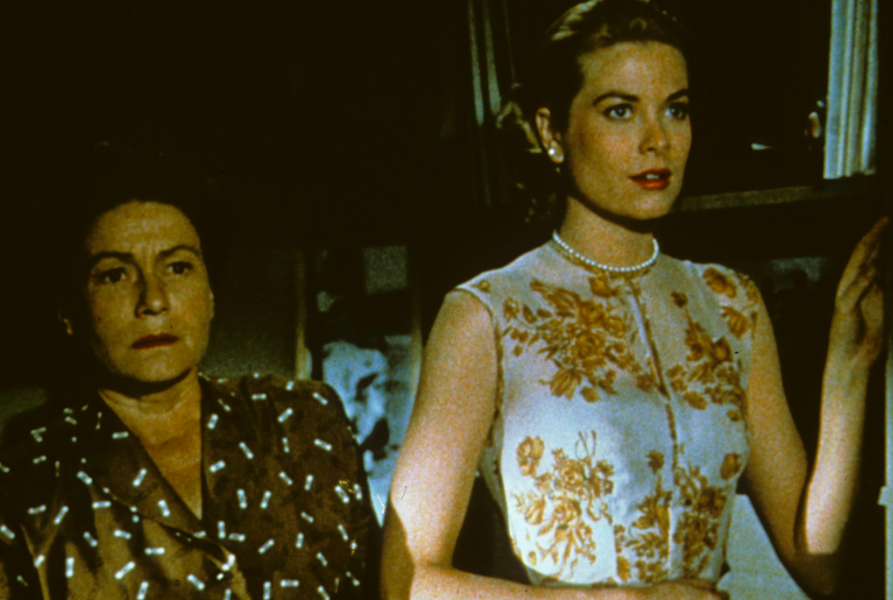
In fact, when Jeff embraces Edmund Husserl’s second phase of studies, that involves intersubjectivity, he will manage to get closer to the truth he is seeking. The perspective of the people visiting Jeff’s apartment will turn out to be essential for this plight. One is Lisa, played by Grace Kelly, a beautiful socialite who is in love with Jeff and wants to marry him. He is uncertain whether his adventurous globe-trotting photojournalist life might be a good match with Lisa’s glamorous life. A second person, frequently visiting Jeff’s apartment is Stella, played by Thelma Ritter, the sardonic insurance company nurse who drops in to check on his leg every day. Last, but not least, is a third visitor: Jeff’s detective friend, Tom Doyle, played by Wendell Corey, who appears later in the film. The shared world between all of these conscious subjects will be the key to the conundrum.
Jeff sees Thorwald take his mysterious journeys late at night and interprets them, along with Mrs. Thorwald’s absence, as proof that he murdered his wife. Yet, having a hunch does not suffice to solve the enigma. As Tom Doyle stressed with Jeff, evidence is indispensable. This quest has its origins in seeing and interpretation.
Jeff is confined to a fixed spot in his apartment, whereas Lisa and Stella can leave his house and go hunting for clues, like when they go in the courtyard, specifically in the flower bed that Thorwald tends. This becomes a potential clue, since the dog that belonged to the couple who slept on the fire escape, dug under the zinnias in search for something and Thorwald shooed him away. When the pooch is found dead, Jeff, Lisa and Stella, feel even more confident that Thorwald was hiding something there. However, when the two ladies left Jeff’s apartment, they took action according to Jeff’s perspective, tracking down information following his indications.
The investigation takes a turning point, once an alternative perspective rises new doubts, that are channelled into a different course of action. Lisa serves as the critical agent in the resolution. She shares Jeff’s same spacial and temporal perspective: they both look outside the rear window of his apartment. However, the same space and time can be interpreted distinctly by different people. Each individual applies the lens of their personal style. Jeff’s approach is more detached and objective. Whereas Lisa relates to one character in particular through empathy and identification. From her interpretative perspective she observes how odd it is that Mrs Thorwald did not take her favourite handbag and jewellery with her…above all her wedding ring. Lisa’s interpretative perspective lets her know what to look for, and when she finds it she has a strong piece of evidence that Thorwald is indeed a murderer. It would not occur to Jeff, from his perspective, to consider the wedding ring as a pivotal clue. But once Lisa presents that possibility, and then succeeds by finding the marriage band, he acknowledges it too.
When we see another person we do not experience them just as an object. We observe the lived body, as Husserl would call it, that goes beyond the physical body, it is a lived centre of awareness that expresses feelings, thoughts, ideas, and the sense of a shared world. Lisa embraces this social experience by placing herself in Mrs. Thorwald’s shoes, epitomising the archetype of the American woman in the Fifties. In that era, the female gender felt tremendous societal pressure to focus on tying the knot. This allows Lisa to concentrate on the evidence that will frame Lars Thorwald.
The recognition of another person’s consciousness is the beginning of intersubjectivity. To Edmund Husserl there is a world horizon common to all, that embraces the particular worlds of each individual. Rear Window shows us how all the homeworlds observed by Jeff, appear within the universal horizon of Husserl’s Lifeworld, represented in the apartment community of the rear windows overlooking the courtyard.
Jeff’s initial approach represents an example of how we tend to judge people’s lives based on appearances. We interpret others at a first glance. We ignore their context. As Professor John B. Brough observed in his essay Showing and Seeing, Rear Window subtly distinguishes between the environing world and a neighbourly world. It is emblematic when the dog’s owner sees her dead pet and tearfully addresses her neighbours from the fire escape, saying they don’t know the meaning of the word neighbours, who allegedly should care for each other. This observation is spot on, since no one besides Jeff took notice of Mrs. Thorwald’s absence, and he might have ignored it too, had he not be confined at home with a broken leg, that transformed him into a nosy Peeping Tom.
Alfred Hitchcock’s classic does leave room for hope for a more empathetic society. At the end of the film suggestions of a neighbourly world do appear. We see Miss Lonelyhearts in the songwriter’s apartment, sitting close to him and we can hear her telling him how much she likes his new song. Their mutual loneliness might have come to an end. Miss Torso, who usually appeared surrounded by admirers, reunites with her awaited sweetheart, revealing that beneath her flirtatious attitude she is ready for a committed partnership. The newlyweds, who had isolated themselves throughout the film, emerge from their honeymoon phase ready to engage with the world around them. The couple whose dog was killed, adopt a new puppy, showing that after suffering a loss, life can renew itself. Most importantly, Jeff sees Lisa in a new light. Her courage has shown that there is more to her than the rarefied Park Avenue society she belongs to, and that she can cope with dangerous situations after all. Therefore there is a prospect of a shared future for them.
Rear Window shows us a horizon of human beings, engaged in an unending interplay of mutual transformation. Perhaps Alfred Hitchcock’s cameo at the beginning of the film — winding the clock in the songwriter’s apartment — might serve as an admonition. The film director could be seen as drawing attention to cinema as an art of lived time. It quietly foregrounds the structure of temporal consciousness itself: the audience watches lives unfolding across windows while suspense depends on anticipation, duration, waiting and timing.
Hitchcock appears both as observer and participant. He is simultaneously the detached orchestrator and the embodied social subject. Phenomenologically, Hitchcock winding the clock while conversing, may turn out to have a dual purpose. Firstly, he reminds us that we have the power to dispose of our time as we wish, and it’s up to us to make the best of it. Secondly, while he is speaking with the songwriter, he is showing us how the world is not private; it is constituted by relations with other conscious beings.
Alfred Hitchcock beckons us to pursue intersubjectivity, and experience others not as objects, but as subjects with intentions, feelings, and perspectives of their own. Hence, Rear Window unveils the ongoing constitution of shared reality, through temporally unfolding perspectival encounters between conscious subjects.