
By Way of prelude
After more than thirty years of existence, Traffic ceased publication in 2022 with its 120th winter edition. The journal was conceived in 1991 by the French critic Serge Daney as his “final intellectual gesture,” a space in which film theorists and critics, filmmakers, and philosophers would reflect on what it means to “live through images” (cinema). Daney borrowed the title from Jacques Tati’s 1971 film Trafic, whose Monsieur Hulot, at the end of his journey, once again meets the absurdity of the world with an irrepressible lightness. After years at Cahiers du Cinéma and Libération – first as a writer, later as an editor – Trafic became, for Daney, a final flash: a brief journey he set in motion himself, stricken with AIDS and facing death.
Thirty years ago, the editorial column of Trafic opened with a question from Serge Daney: “What can resist?” followed by another: “What can withstand the market, the media, fear, cynicism, stupidity, indignity?”
In the first issue of Trafic, Giorgio Agamben, in his essay “Notes on Gesture,” ascribes to silent cinema a function of resistance, regarding it as humanity’s last attempt to recover the lost gestures of the Western bourgeoisie – “after the dance of Isadora Duncan and Sergei Diaghilev, the novellas of Proust, the magnificent Jugendstil, the poetry of Pascal or Rilke.”
“By the end of the nineteenth century, the Western bourgeoisie had lost its gestures entirely. In cinema, a society that has lost its gestures tries at once to reclaim them and to record their loss. For people who have lost every sense of the natural, each gesture becomes a destiny. And the more gestures lose their simplicity through the action of invisible forces, the more inexpressible life remains.” (Giorgio Agamben, Notes on Gesture, 1991)
So then: cinema, life, resistance… Is it possible for time in cinema to become a time of resistance? A place of resistance? A city of resistance? A street of resistance? Is cinema capable of resistance—cinema in which resistance exists only insofar as there is a fairy tale woven out of reality itself: love, magic, and enchantment? And can this reading of the world still move us, can it still enrapture the one whom, as Pascal says, “even the originals can no longer move”?
The filter-tinted images prepare the viewer, from the very first moment, to see an interpretation of the world, the exalted moments of everyday life, “with a different eye and with wonder”
Hello, Language!
Soon after the history of cinema began, the new art was greeted with a book – Hello, Cinema by Jean Epstein; later, directors would bid farewell to the language of their own cinema with a film- Goodbye to Language by Jean-Luc Godard. Between this greeting and this farewell, there is surely something with which one might greet the very birth of language itself in texts on cinema: as if to say, “Hello, Language!”
In 1886, Gilles de la Tourette published the first clinical studies in human history on walking—studies through which the most ordinary of human gestures were examined. For Giorgio Agamben, this neuroscientific research – where Tourette’s gaze describes the movement of his patients’ feet with a kind of cinematographic precision- becomes a prophecy of what cinema would later accomplish. Observing the reproductions of those footprints, Agamben is reminded of the sequence of frames that Muybridge, before the Lumières, captured at the University of Pennsylvania using twenty-four photographic lenses.
“‘A man walks at a normal pace,’ ‘a man runs with a weapon,’ ‘a woman carries a jug,’ ‘a woman blows a kiss as she strolls’ – these are the happy and visible copies of those unknown and tormented creatures who left their traces behind.”
An open door. Through it, children leave school with their usual lightness. “The truth of pathetic gestures lies in life’s great moments” (Baudelaire); here, alongside the children, even the bodies of the adults seem to share the language of pathetic gestures.
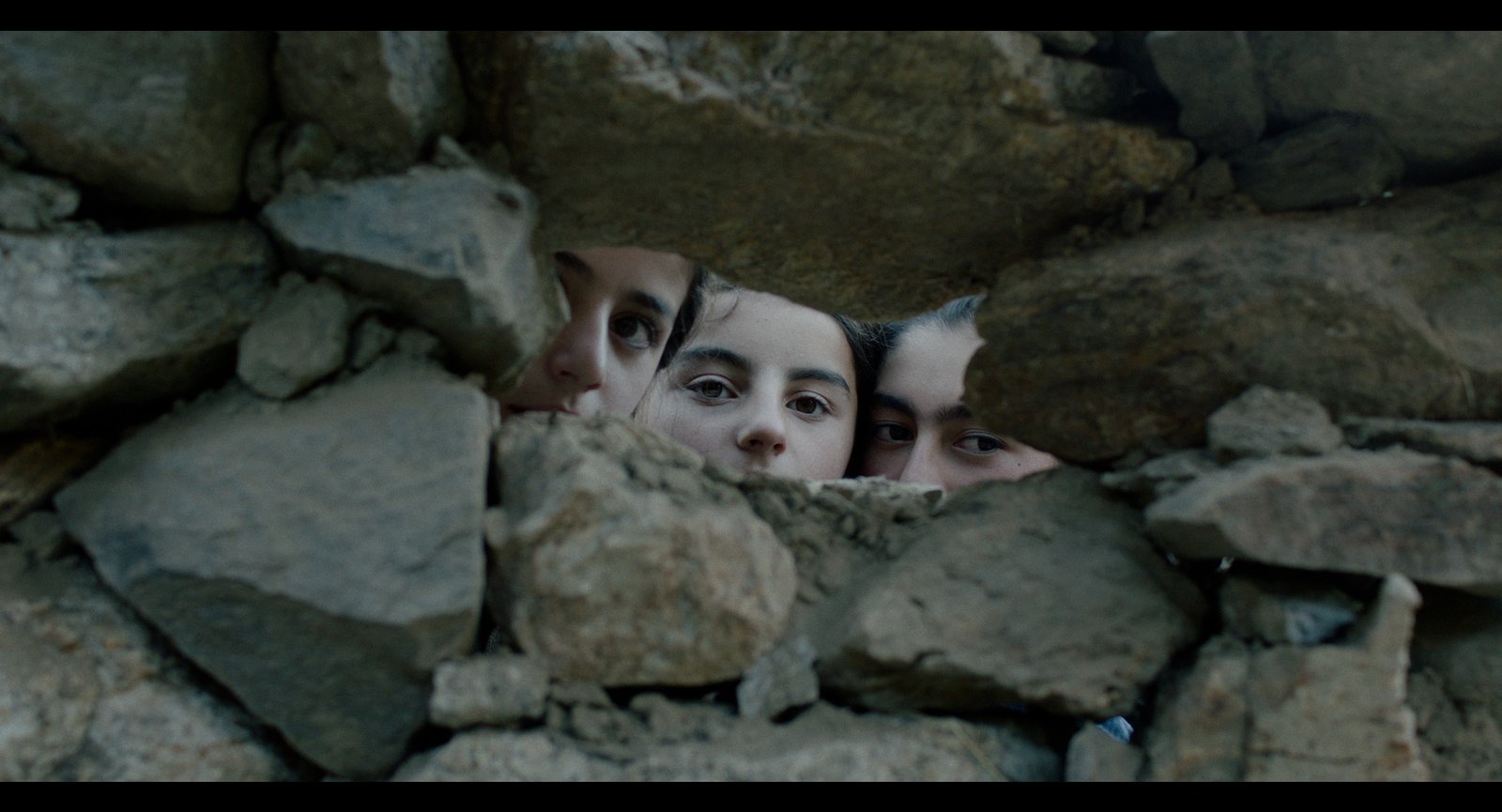
Alexandre Koberidze begins his film What Do We See When We Look at the Sky? (2021) with the banality of the Lumière brothers’ first films and early silent cinema—people strolling in the street, children at play, the arrival of a train. The filter-tinted images prepare the viewer, from the very first moment, to see an interpretation of the world, the exalted moments of everyday life, “with a different eye and with wonder” (Éric Rohmer). This continues until a cut in the montage – a lyrical digression – forces the viewer’s gaze toward a point chosen by the camera (a zoom), while the music (by composer Giorgi Koberidze) creates in the viewer’s ear a sense of fairy-tale enchantment, of Méliès-like sorcery, of “love at first sight,” as a small bird briefly returns to the frame and then leaves it again. The first “zoom,” from the very beginning, plants in the film’s narrative chain a kind of “crystal” that, over the course of the 150-minute film, gradually develops language and story in concentric circles.
Collision Was the First Lesson
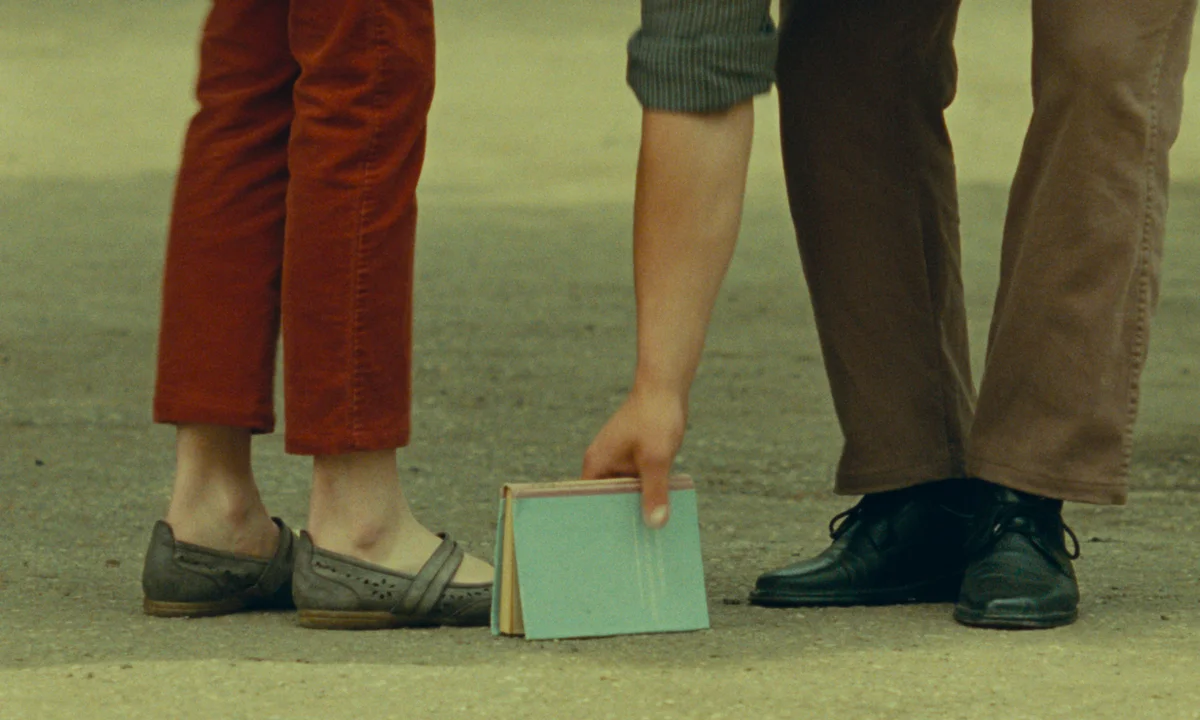
The director begins the story of the lovers (Lisa, a pharmacist; Giorgi, a footballer) – a couple who find each other through chance and, through that same chance, will lose each other (and yet, “coincidences are reliable”) – with a fateful gesture: a mechanical collision in a place entirely emptied of people, as if on a blank sheet of paper. Unlike modern cities, where collisions in crowded spaces become a compensation for the loss of any capacity for touch, the director shows us a Badiouian “collision,” after which confusion and a sense of irreparable loss follow the protagonists into their workplaces, their homes, and their rooms. With the “image” of the collision, the author deliberately “hides” the lovers’ faces and feelings; instead, he shows their walk – these figures who no longer command their own hands and feet – momentarily returning the viewer to Tourette’s “unknown and tormented creatures,” whose walking was once studied, and linking this, in turn, to Muybridge’s series of frames, through which these same “unknown and tormented creatures” take on the appearance of “happy and visible copies.”
The director turns the characters into sorrowful, “tormented and alien” copies of themselves who, together with their bodies, lose one another (unable to recognize each other in the café) as well as their own abilities
Your Sorrowful Copies
Alexandre Koberidze “hides” the faces of the protagonists (the “image-affect”) later as well, when, against the backdrop of the city’s panoramic view of Kutaisi, they decide to trust chance no longer and to meet at a café by the White Bridge. Despite the camera’s estrangement from the lovers’ faces – as in Bresson – the characters’ bodies and unexpected gestures convey their feelings and sensations without any need for explanation.
With the sudden appearance of an off-screen voice, the director – like the benshi, the narrator of silent cinema – turns the city into the lovers’ shifting ally and adversary. Through “fairy-taled” objects – a seedling, a surveillance camera, a gutter, a breeze, and the sound of a passing car – the urban space takes on a logic of magical realism, one that partially reveals to Lisa the approaching danger. These fragments point to the curse of the evil eye, under which, one day before the date, the protagonists will lose their own bodies.
The seedling, the surveillance camera, the gutter, and the breeze acquire fairy-tale meanings in the film, much as the willful agency of objects does in April (1961) by Otar Iosseliani, where the sudden switching-on of a lamp, the arrival of water, and the lighting of gas produce in the viewer the effect of a fairy tale.
The “crystal” that, at the start of the film, “drops” lightly into the narrative chain takes on, after the appearance of the evil eye, a more dramatic countenance – through a moment-by-moment sensation of suspense, as concentric circles widen. The drama woven between the director’s words and the images of the seedling, the surveillance camera, the gutter, the breeze, and Lisa’s face acquires a lyrical quality in the painting with light on objects and the face, between the falling and the fading of light (cinematography by Faraz Fesharaki).
This absolute change of tone emerges from cinematographic lyricism as a radical shift, a merry avant-garde game in which the director’s voice and an intertitle call upon the viewer first to close their eyes and then to open them again, on the count of three. Between the viewer’s closed and opened eyes, the director turns the characters into sorrowful, “tormented and alien” copies of themselves who, together with their bodies, lose one another (unable to recognize each other in the café) as well as their own abilities – Lisa her pharmacological expertise, Giorgi his footballing talent.
Instead of the “dramatic progression” of the Aristotelian fable, Alexandre Koberidze offers the viewer an endless series of dramatic progressions
The City Is a Magic Flute!
This simple, primitive story of love (a meeting, a loss, a meeting again), unfolding on the border between the real city and the city woven by the camera (everything is as real as it is magical, and vice versa), gradually becomes, within the film’s narrative chain, a crystal that develops the plot as a fallen drop sends concentric circles rippling across water. Thus the city, with its visible and invisible inhabitants (children and dogs), its passions (singing, eating ice cream, playing football), and it’s past and present (of which the narrator tells us), gradually becomes part of the whole- part of the enchanting circle of love (or of life?!) (“Mikheil Meskhi, when asked, ‘What is love?’ draws a circle.”) The lovers’ gaze, which the director makes a secret at the start of the film by “hiding away” their faces (“we do not know what the face of the one who loves looks like”), may present itself to us as a continuation of the camera’s gaze – a gaze that lets the viewer behold the world seen through the untrained eyes of a person in love (a miracle here can happen at any moment).
While the protagonists’ lonely and sorrowful copies – estranged from the world and from their own labor – learn to live for a while apart from one another (Lisa at the ice-cream machine, Giorgi nearby, at the beam), the music of Kutaisi – like that of a magic flute, whose sound is heard only by the one who plays it – reaches the viewer, with the director’s help, through every element of the city: its streets and cafés, the Rioni and its bridges, the crossroads and traffic lights, Mount Khvamli, the statues, the bushes and flowering trees, the adults, the children, the dogs and their shadows, the reflecting surfaces, the football, and the director’s own voice (the off-screen voice).
Instead of the “dramatic progression” of the Aristotelian fable, Alexandre Koberidze offers the viewer an endless series of dramatic progressions: objects transformed in appearance by the power of fantasy (the mind is “an illuminated projector”); children hanging from a beam; dogs that have wandered off to cheer at a football match; people who have gone to Skhvitori for cake; football played against the backdrop of “magic nights.” Here, real time (which they will “remember … most cruelly”) demands that, amid the director’s free, long, and uninterrupted movements, life itself become beautiful at a distance.
“Life is not concerned with stories and actions oriented toward an end […] but with long and continuous movements composed of infinite micro-movements.”
A Fugue for Life!
In the film’s narrative, long, uninterrupted movements interweave like the voices of a fugue – complex and yet easy to listen to. Within this polyphony, the appearance of the World Cup, which Argentina will win, sets free a passion that takes the form of a “universal song,” suspended between the breaking of the bewitched couple’s spell through film and the truth of the children’s pathetic gestures (they press toward the future, they climb the stairs).
This story of love, which demands a deciphering akin to that of a musical score – where the director, at each setting-in-motion of the concentric circles, might have been lost amid gigantic orchestral masses and a profusion of details – ultimately turns from a love story into a delicate fugue of life (Sunrise): one that reveals to the viewer the festivals of an everyday life emptied of savagery, phantasmagoric rituals, whirlwinds moving in silence, delicate cycles, and ceaselessly changing rhythms; a cinematographic lyric “wounded with precious wounds, with the melancholy of the century” (Georgia poet, Valerian Gaprindashvili) – a lyric that, “in its own kingdom,” ushers into view the history of this country, of that city, and of our cinema- Georgian and world cinema alike – as if it were an apparition, through paths as varied as the very instruments by which the viewer