

With Mandrakizay Doria (À tout jamais) (2026), Malagasy filmmaker Franco Clerc makes an ambitious feature debut that combines romance, fantasy and historical memory. Adapted from a successful stage play, the film is divided into seven chapters and unfolds across 155 years, from 1869 to 2024, centred on a quest for seduction.
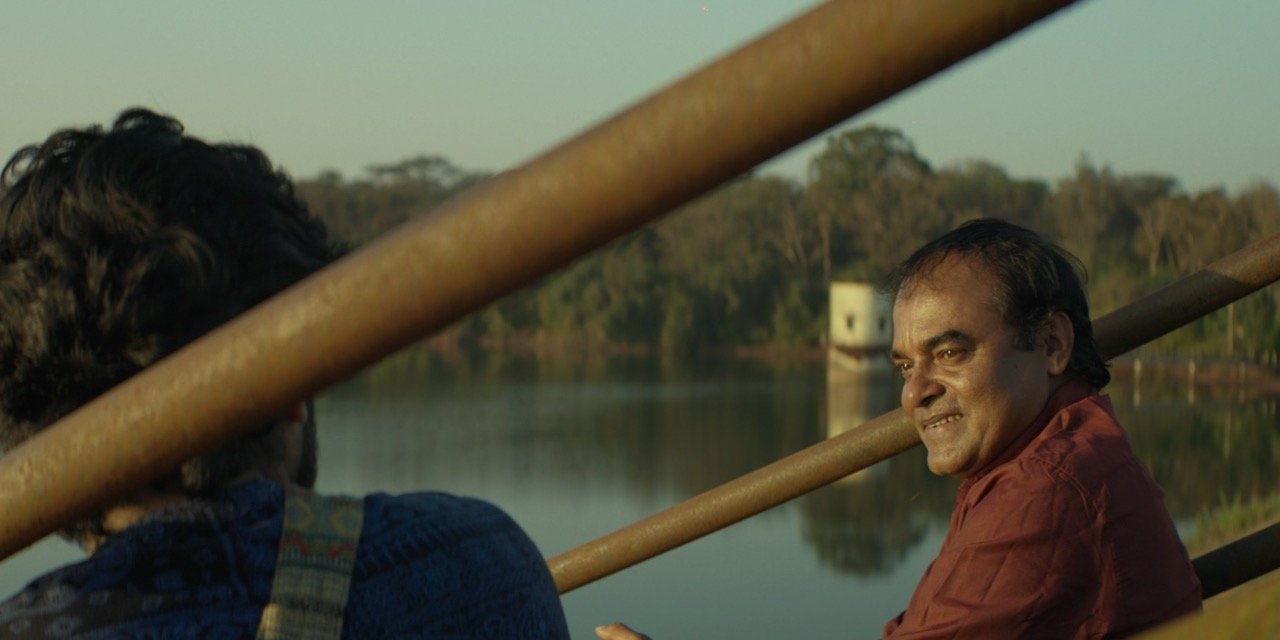
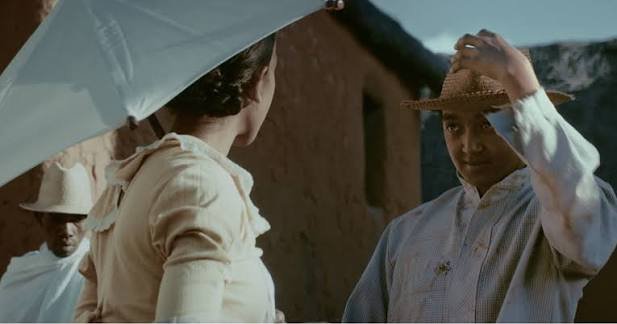
The film opens in 1869, during the era of the Malagasy monarchy, specifically under the reign of Ranavalona II. Railovy (Rolland Raman), a humble peasant from the Central Highlands, falls in love with Lala (Synthia Saga), an aristocrat whom he meets at the public market. We observe with amusement the courtship codes of the period: a man stepping on a woman’s “lamba” (silk shawl), as well as the use of “hainteny merina” (poetic sayings) to declare his love.
Despite all these efforts, Lala seems uninterested in her suitor’s advances. While Railovy broods over his failure, alone in the fields, Ary (Stéphanie Razakaratrimo), an ancestral deity who appears out of nowhere, offers to grant his wishes. Ary resembles the Genie of the Lamp from the tales of Arabian Nights: she cannot harm humans, bring the dead back to life or make people fall in love. Since she cannot make Lala fall in love with him, Railovy asks Ary to help him win her over by turning him into a magician.
However, Railovy’s magic tricks fail to change the situation. Entirely unimpressed, Lala remains beyond his reach. In a gesture of pride and frustration, he casts a spell that condemns them both to eternal youth: “You will see: wherever you go, whatever you do, the earth, the sky and the elements will bear witness; neither you nor I shall grow old until your heart beats for me.” Over the course of the story, Railovy’s obsessive nature and his determination to seduce Lala at any cost lead him to cross boundaries that will bring about his downfall. Yet the narrative does not end with that fall: it also offers him a possibility of redemption, although it can only be attained through a great sacrifice.
Cultural authenticity and remarkable performances
One of the major achievements of Mandrakizay Doria lies in its ability to root the fantastical in Malagasy culture. The film draws on local legends and traditional forms of expression: the proverbs of the elders, words inherited from the ancestors, dialects and oral traditions. The nineteenth-century costumes, including the malabary and white lamba, as well as the sets, contribute to this cultural immersion and give the narrative an unmistakably heritage-rich texture. The original music, enhanced by valiha melodies composed by Linda Volahasiniaina, further strengthens this atmosphere by placing the fantastical within a soundscape deeply rooted in Malagasy identity. This concern for authenticity extends to the reconstruction of the different periods covered by the story. Since the film includes an important sequence set in the 1960s, the costumes, props, hairstyles, make-up, manners of speech, vehicles and overall atmosphere reveal a genuine commitment to historical coherence. The careful choice of locations and framing also contributes to this: the places selected and filmed are free from anachronisms.
The deliberately understated directing style places the emphasis on the performances of a strong and experienced cast. Before Mandrakizay Doria, Rolland Raman had played a manipulative magician in Franco Clerc’s short film Game Over (2023). Synthia Saga also appeared in that film, as well as in Jérémie Andriamparany’s historical film Tsara Joro (2025), in which she plays Queen Ranavalona III. Stéphanie Razakaratrimo, meanwhile, has already distinguished herself in several short films, including Ketaka Razafimisa’s Her Little Piece of Heaven (2015), Rindra Rambeloson’s Batardes (2024) and Anton Khan’s Followers (2024). There is also a clear understanding of the characters, helped by the fact that two of the three lead actors, Synthia Saga and Rolland Raman, co-wrote the original stage play on which the film is based with multidisciplinary artist Joey Aresoa. The precision of their performances rests on a command of acting developed through their training at the EKAA Artistic Agency School.
However, despite all these qualities, the screenplay contains numerous grey areas that leave the viewer uncertain and speculating.
The screenplay’s grey areas
In narrative terms, Mandrakizay Doria makes use of substantial temporal ellipses that raise as many questions as they do mysteries. After Railovy casts the spell condemning both himself and Lala to eternal youth, the story jumps from 1869 to 1965, 96 years later. Railovy now calls himself “Lova The Great Magician”; he is an itinerant magician, and Ary has become his assistant. While he is performing before a packed audience, Lala happens to be among the spectators. This narrative coincidence, for which little justification is offered, primarily serves to move the story forwards. During their reunion, we learn that in the intervening years Lala has attended art school, painted pictures, explored Madagascar, discovered its 18 ethnic groups and 11 dialects, and even learnt Kibosy, a Malagasy dialect spoken in Mayotte, where she met Bertrand, a French soldier whom she is soon to marry. By contrast, we do not know what Railovy has done during all that time. How did he lose track of Lala when his magical powers should have enabled him to find her? Has he never fallen in love with other women? How did he experience the colonial period? Why is he still a magician seeking national recognition, when a man who never ages and possesses such powers should logically have become a major social phenomenon? Besides this, the Railovy and Lala of 1965 closely resemble their 1869 selves. Is that psychologically credible? The eternal youth that preserves their physical appearance should not prevent time from affecting their personalities. Almost a century of life, involving encounters, discoveries, experiences and historical upheavals, should logically have had an impact on them. The 59-year ellipsis between 1965 and 2024 also raises several questions that we prefer not to address here in order to avoid spoilers.
Furthermore, Railovy becomes a magician thanks to Ary, whose powers are clearly limited: she can neither harm humans nor bring the dead back to life nor make someone fall in love. Beyond this, however, we are not given enough information about the rules governing the story’s magical universe. For example, the film does not clearly state how many wishes Railovy may ask Ary to grant: is he entitled to one wish or several? What is the scope of Railovy’s powers, and what are their limits? Additional elements, such as death karma and love karma, further complicate an already unclear system.
Although Mandrakizay Doria occasionally loses us amid all these questions, it stays its course and delivers an emotionally resonant ethical message about the importance of authenticity in matters of seduction and of respecting another person’s boundaries, because love must be freely given and cannot be forced.
At the closing ceremony of the second Madagascar Film Festival ISSM Awards, held on 23 August, Mandrakizay Doria won the award for Best Film in the fiction feature category.
Mandrakizay Doria (À tout jamais) — Madagascar, 2026, 108 min. Directed and adapted for the screen by Franco Clerc. Based on the play by Joey Aresoa, Synthia Saga and Rolland Raman. Production: Films and Comics. Original music: Linda Volahasiniaina. Cast: Rolland Raman, Synthia Saga and Stéphanie Razakaratrimo.