
Two elections could decisively shape the state of the world in 2027. This Sunday, Brazil holds its presidential run-off between the left-wing incumbent, Lula da Silva, and far-right candidate Flávio Bolsonaro, son of former president Jair Bolsonaro. Polls show a statistical tie, leaving the outcome wide open. Just over a week later, on 3 November, the US midterm elections could strip the Republican Party of control of one or both chambers of Congress, limiting Trump’s room for manoeuvre. These contests unfold in different contexts, yet both are marked by the strategic and manipulative use of social media, in an age when politicians blur into influencers and vote counts seem an extension of follower counts.
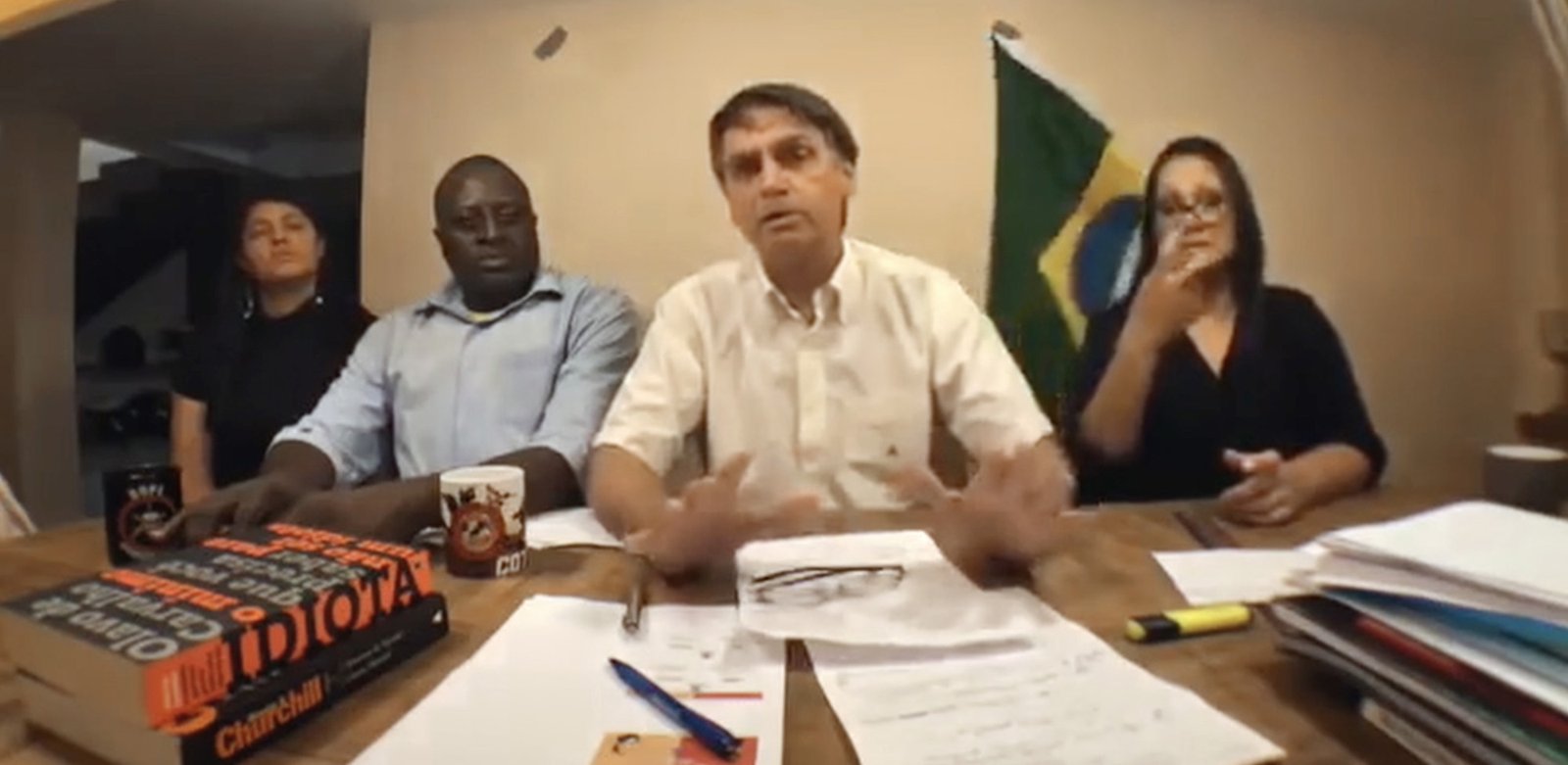
In Dragões, which receives its international premiere at Doclisboa, Miguel Antunes Ramos dissects the videos Jair Bolsonaro has posted on his YouTube channel over the years. He examines them from a semiotic perspective, using the tools of a filmmaker. It is a meticulous attempt to understand the phenomenon: the visual transformation of a drab man associated with the military dictatorship into an influencer capable of drawing crowds, mastering the mobile phone camera as a means of propaganda.
Fascist regimes had their filmmakers and knew how to exploit cinema as an instrument of communication and propaganda. Curiously, one of the investigations involving Flávio Bolsonaro concerns precisely the financing of Dark Horse, a film about his father.
Cinema, however, has lost ground as a propaganda weapon to the torrent of images on social media. Bolsonaro recognised this at the right moment and explored the terrain of pixelated mobile phone images with an instinct as productive as it was intuitive. In a sense, he is his own Goebbels, his own Leni Riefenstahl: the proto-dictator becomes the filmmaker of his own proto-regime. Yet his cinema is far removed from the German director’s grandeur. It is a small-scale, deliberately crude cinema, able to fit into the pockets or palms of a vast, ever-shifting audience.
Miguel Antunes Ramos makes no secret of his fascination with Jair Bolsonaro’s visual construction. An obsessive fascination, driven by a desire to understand and deconstruct the elements behind his rise, while acknowledging his intuitive intelligence. He never underestimates him. This matters. The filmmaker plunges into the enemy’s visual territory to decode and understand him as a phenomenon. It is a bold and perceptive move: he takes him seriously and seeks to understand his inner workings, his schemes, his motivations.
The film does not even need to spell out its position or devote itself to exposing the former president and his copious lies. In Jair Bolsonaro’s case, simply laying out his rhetoric is revealing enough. He is no fascist creeping in on tiptoe. He is a fascist through and through: an advocate of torture, a chauvinist and a misogynist, who makes the most atrocious pronouncements against democracy without batting an eyelid.
Miguel Antunes Ramos begins with the construction of one of Brazil’s great founding myths: “Independence or Death!”, the cry uttered by Dom Pedro at Ipiranga and immortalised in Pedro Américo’s painting, displayed at the Ipiranga Museum in São Paulo. Myth is understood as a construction that exceeds reality and ultimately supplants it. The painting offers a heroic staging of the event, fixing an image that has become inseparable from national memory. The uniform of the Independence Dragoons, the presidential guard that gives the film its title, is based on the colours Pedro Américo imagined in his painting, rather than those worn in reality.
Antunes Ramos’s analysis opens up several hypotheses. One of the most fascinating concerns the importance of low definition. Jair constructs himself through pixelated images in which his face is barely discernible. He becomes the crowd. It is this collective space that he magnifies: the leader no longer even needs to be in focus to remain in the picture. The “myth” acquires autonomy, becoming a lasting force that extends beyond his presence. This hypothesis also offers a way of looking at Flávio’s electoral support: he perpetuates an idea without even needing to record daily videos, as his father did.
This pixelation also carries something of Big Brother. Departing from the political tradition of carefully preparing for the cameras, Bolsonaro represents a category of politicians for whom everything continues once the television cameras switch off. In truth, the camera never switches off: the mobile phone ensures a permanent live broadcast, in which attention is measured in followers and likes. Even after being elected, Bolsonaro continues to produce videos seeking approval on Instagram. He proves as pathetic as he is effective.
Within this semiotic construction, the spectacle is also the message. The effectiveness of the images allows atrocious political positions to circulate under the guise of spontaneity and closeness. Defending torturers or advocating measures that harm his own electoral base does not prevent identification with the leader. As the filmmaker observes, the message is being heard: it is precisely this allegiance that needs to be understood.
Dragões is a work of immense importance for making sense of the contemporary world. It is also a fascinating piece of cinema, intelligently constructed, which approaches the proto-dictator’s footage with the same seriousness one would bring to interpreting the symbolism of a major cinematic work, even when its apparent crudity and carelessness seem to place it at the opposite extreme from cinema as art.
Director: Miguel Antunes Ramos
Screenplay: Guilherme Giufrida, Iris Junges, Letícia Simões, Matheus Nery, Miguel Antunes Ramos, Vicente Antunes Ramos
Cinematography: Léo Bittencourt
Editing: Alexandre Leco Wahrhaftig
Sound design: Henrique Chiurciu, João Victor Coura
Music: Kiko Dinucci, Podeserdesligado
Producers: Leonardo Mecchi, Julia Murat
Production companies: Enquadramento Produções, Esquina Filmes