

What should happen in a place where, by every logic, a conflict ought to begin; where everything should belong to the winner, while the loser should be left alone?
The history of cinema is full of such divisions. On one side stands Chaplin, on the other, Keaton. Two opposing languages of comedy, two opposing tempos, two different ways of seeing the human being, the body, space, even laughter itself. One moves like quicksilver, whether he is being thrown out or running away, submitting or taking control, he makes us laugh through the excess of his emotions. The other stands as still as marble. His expression never changes; every absurdity in the world passes through his stone-faced gaze.
Film lovers, too, are faced with a choice: between Chaplin’s warm, emotional chaos and Keaton’s cold, almost mathematical order.
The great turning point in cinema, the arrival of sound, takes nothing away from the former. On the contrary, it makes him even stronger. The latter, however, is almost entirely swallowed by the new language of sound cinema and the changes in the industry. So much so that even Peter Bogdanovich, a fortunate man who meets almost every great American director of his time, never gets the chance to meet Keaton, the one exception.
Time itself decides the fate of the rivalry between Keaton and Chaplin. Keaton disappears; filmmaking becomes a thing of the past for him, and his face slowly fades from the audience’s memory. Chaplin, meanwhile, is still in form. In sound cinema, his Tramp now takes on dictators.
In 1952, Charlie Chaplin brings this historic division to an end himself by inviting Buster Keaton to appear in Limelight, at a time when Keaton is going through one of the most difficult periods of his career. Chaplin could simply have carried on along his own path, already celebrated across the world, almost mythological in status. Instead, he finds a place for Keaton in his own universe.
In Limelight, Chaplin is still Chaplin: still the cane-wielding clown, slightly absurd, left alone against the world. Time has left its mark on Keaton’s face, yet his expression remains almost unchanged, still calm, still wrapped in his stone-faced silence. Chaplin at the violin, Keaton at the piano: their duet is doomed to fail from the very beginning. The instruments break down, the movements get tangled, the rhythms refuse to align. And yet, in the end, all this chaos creates a rhythm of its own.
In this unity, the differences do not disappear. Chaplin does not become Keaton. Keaton does not become Chaplin. One keeps moving, the other remains, for all practical purposes, motionless. Yet their different rhythms meet, separate, come together again and, ultimately, work in unison. This is the chemistry of unity.
With Keaton’s Face and Chaplin’s Heart…
“In fact, I am both Chaplin and Keaton at the same time.” For the Finnish director Aki Kaurismäki, there have never really been two opposing camps. His affection shifts, now and then, between Buster Keaton’s “pale face” and Charlie Chaplin, cinema’s great outsider, its melancholy clown.
From 1983, when he made his directorial debut with Crime and Punishment, to 2023, when his latest cinematic fairy tale, Fallen Leaves, appeared on screens, Kaurismäki’s cinema has drawn these two loves together: Keaton and Chaplin. Over those forty years, time changes, political processes shift, new wars begin, new dictators fight one another, and new oppressors search for new ways to oppress. The ordinary person, meanwhile, continues to hear about it all on the radio or television: students shot dead in Tiananmen Square and the death of Ayatollah Khomeini (The Match Factory Girl); the dismantling of the migrant camp in Calais, France (Le Havre); the bombing of Mariupol and Russia’s war against Ukraine (Fallen Leaves).
And yet, in Kaurismäki’s world, in his stylised Akiland, some things stubbornly refuse to change. Here, political time is inactive, its rules disregarded from the outset. In the real world, another migrant camp may be dismantled in France, but within the film’s own time, this cannot prevent Marcel Marx and the whole of Le Havre from helping to save a little immigrant boy, Idrissa. Within Akiland’s monolith, real time is always defeated by something greater than itself, just as it is in a fairy tale. Historical time seems to pass without protest, yet each time it finds itself defeated by the film’s ethical order.
Fragments of eternity are scattered throughout Akiland, in every corner: in its invisible ethical order and its visible, transient aesthetic details. For Kaurismäki, the setting remains Finland, occasionally France or England; still the outskirts of Helsinki, cafés and bars full of outsiders; still the jukeboxes, whose music carries on telling the stories unfolding in the characters’ hearts. Because his characters cannot express what they feel through their faces, words or movements, the emptiness of the frame is filled with the emotional excess of music. And so unity takes shape: between the characters’ restraint, the song’s excess and the audience’s ability to understand. Kaurismäki’s characters still fight their difficulties with alcohol and cigarettes, through ritual repetition. Their world seems frozen somewhere between the 1930s and the 1980s. Old cars, radios and telephones, clothes and interiors, bohemian songs drifting out of bars and jukeboxes all suggest a world that modernity has never quite reached. Technology changes, the world moves forward, but the domestic monsters remain the same: unemployment, the loss of a job or a home, loneliness, isolation, bank debts…
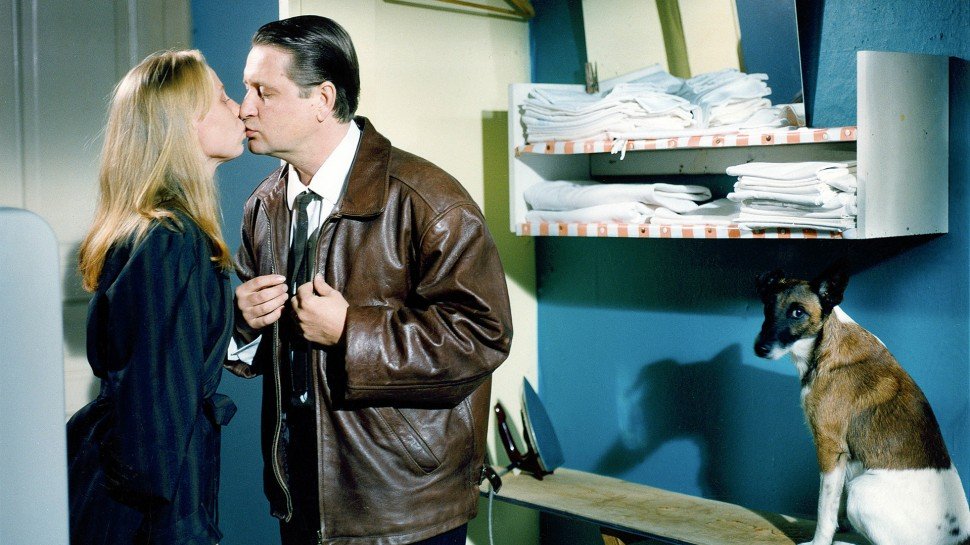
Across these forty years, Kaurismäki’s cinema has retained an almost unchanged grammar: a static camera, laconic dialogue, long pauses, Keatonian restraint and Bressonian asceticism, rigorously composed frames, vivid colours, tango, rock ’n’ roll, and the characters’ best friends: dogs whose names we know by heart: Baudelaire (La Vie de Bohème), Pietari (Drifting Clouds), Laika (Le Havre), Hannibal (The Man Without a Past), Koistinen (The Other Side of Hope). In Fallen Leaves, the passion for unity goes so far that, in the final scene, Ansa names a stray dog she has found Chaplin. It is as though Kaurismäki is no longer satisfied with loving Chaplin. He is ready to give everything he loves a home in one world: Akiland.
All of this creates the chemistry of unity. The impassive face of the protagonist is always Keatonian, but the world is always governed by Chaplin’s principle of compassion. Akiland is a place inhabited by characters with Keaton’s faces who live with Chaplin’s hearts. Kaurismäki’s Tramp becomes, at times, a factory worker (The Match Factory Girl), a restaurant waitress or a tram driver (Drifting Clouds), a welder (The Man Without a Past), a shoeshiner (Le Havre), or a supermarket worker (Fallen Leaves). He becomes a human being whom the modern system, much like the legendary Tramp, drives away before he can cross any threshold. Before becoming a director, Kaurismäki himself worked various jobs: as a postman, a dishwasher, a labourer. This is the face of Finland he knows, the Finland he understands. In his world, working people are always left standing on thresholds, in front of doors that have been shut against them.
For forty years, the sense of unity in Aki Kaurismäki’s cinema has remained almost unchanged. His brother Mika Kaurismäki is still his producer; actors return from time to time to work with him again: Matti Pellonpää, Kati Outinen, Kari Väänänen, Markku Peltola, Juha Viritanen. They grow older over time; some are no longer alive. Drifting Clouds is dedicated to the memory of Matti Pellonpää, the actor for whom the film’s leading role had originally been intended. The inhabitants of the director’s cinematic universe return from film to film, as one returns home, to Akiland, a place inhabited by faces that are anything but glamorous.
Kaurismäki lives between Finland and Portugal, where he stays only in winter, but he has never made a film in the latter. “I still don’t understand these people,” he says, returning again and again to Helsinki. And yet he cannot quite let go of France either. For a cinephile, a country can exist first in cinema, and only later in reality. Kaurismäki’s Paris bears the traces of Melville, while Le Havre bears those of Carné. So when he films the city in Le Havre, he is not simply showing us a port. He is filming a city he has already seen, a city preserved in his cinematic memory. Jean Gabin’s ghost seems to follow the film, too, walking through the mist-shrouded port of Le Havre in Marcel Carné’s Le Quai des brumes. Kaurismäki seems to return to the same city, only decades later, in a different time, among different people, his own drifters, with their dreams and hopes. In this way, the chemistry of unity in his cinema extends to geography, too: the real place and cinematic memory are fused within his imagined world, a world that stands slightly apart from reality. Kaurismäki’s Finland, like his France, is partly real, partly learned, partly made of cinema and, ultimately, entirely his own.
This cinema has Keaton’s restraint and Chaplin’s compassion. The world remains hopeless; unity and solidarity remain the only hope.
This essay accompanies the Aki Kaurismäki Retrospective, presented by CinExpress and Finland in South Caucasus at the Cinema House in Tbilisi, 20-22 November 2026.
Curated by Nini Shvelidze, Alexandre Gabelia, and Giorgi Javakhishvili.