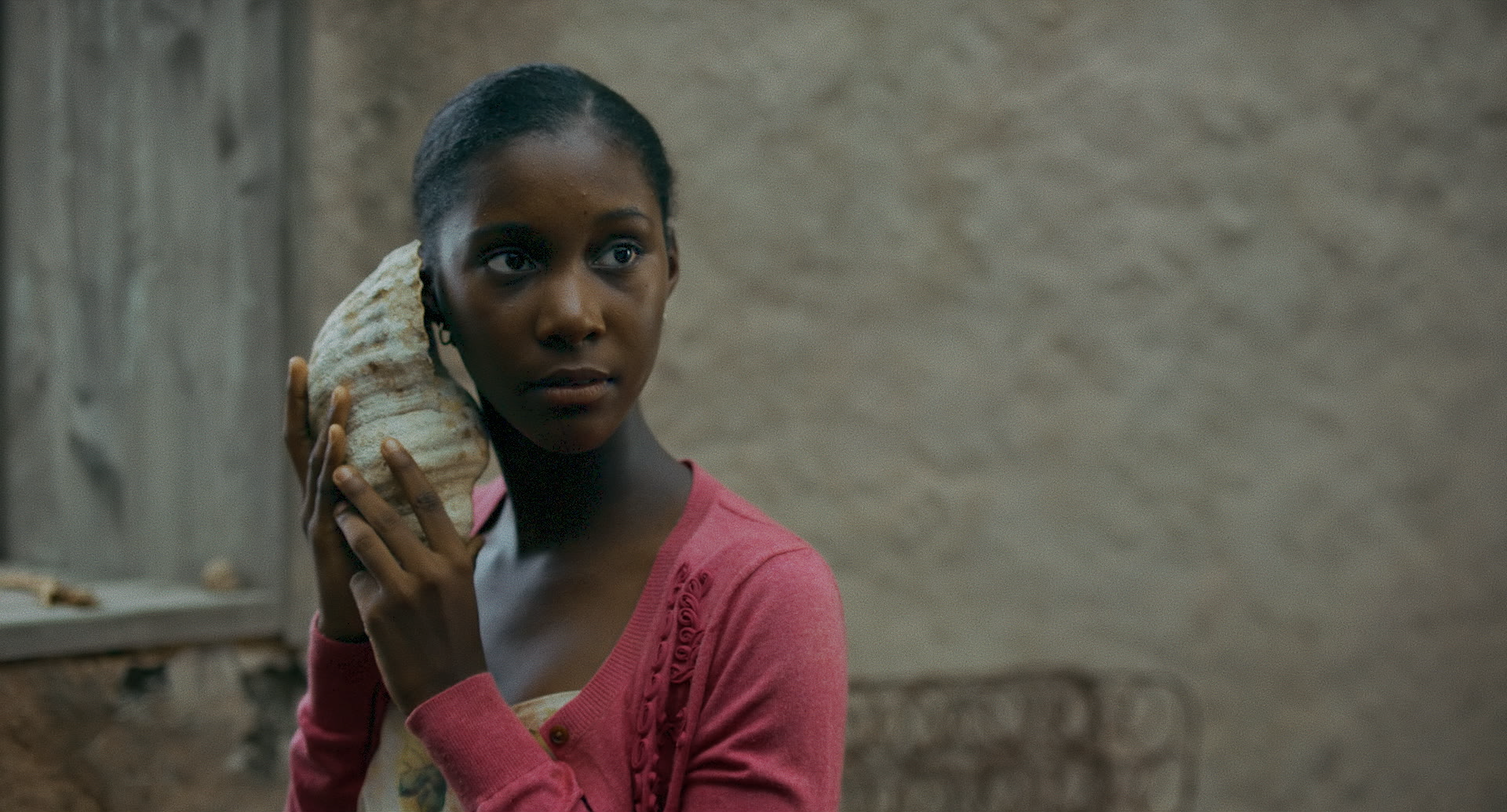


If Los Días Libres can be understood as a pre-feminist film, even though gender is addressed in an extremely discreet and almost incidental way, Destroy All Girls is a female and feminist case study within a very particular context, while At Night is a politically engaged film about the struggle of women, as well as that of racialised and socially marginalised people. With Brave New Love, which also premiered at Locarno, we may be facing something that could almost be called post-feminism. Not in a conformist sense, but a utopian one, as it suggests a society that has evolved to the point where discrimination against women has been overcome. Utopian in that sense, and in no other.
Maria Bäck’s Brave New Love can be seen as an essay on infidelity, insofar as it appears to construct a scenario designed to test a thesis and then uses its narrative device to stimulate debate. One great big “What if…?”. What if a woman cheated on her husband in a happy marriage, not because he was violent, because she had a difficult relationship with her mother or because the marriage had run its course, but simply because she fell in love with another man? What if, despite falling viscerally in love with this man, she never stopped loving her husband in a steadier, more sober way?
The easiest observation would be that Nordic people lead lives that are all too easy and well ordered, with exceptional living conditions and a high quality of everyday life, and are therefore terribly bored. At the opposite extreme from the characters in At Night, they invent things to jolt themselves out of their numbness. Things such as photographing themselves naked in the lake, attending a women’s group at church, taking aerobics classes or finding a lover.
It is telling that, in the church group, which is more progressive than some communes, they try to find an explanation for the affair and ask her: but doesn’t your husband help around the house? The problem does not lie with her husband, to whom she feels close, but with her lover, who continues to fill her thoughts and perhaps her heart even after moving to Greece.
The film centres on a female character with a strong sense of humour. Much of its charm lies in the way her affair is naturalised and stripped of drama, in how she discusses it openly at church and neutralises any moral questions. After all, nothing could be more natural than people falling in love. The film also shows how tangled such situations can become. Of course, if it were a man doing the cheating, the character would be unbearable. Because she is a woman, we can tolerate her, albeit only up to a point.
When her world collapses, however, the film reverses direction in a way that becomes abstruse. It is difficult to accept the extreme victimisation of this woman, who has cheated and who, on the whole, has been treated well despite her betrayal. She is almost infantilised, much like her own daughter. The final section of the film, which strives for greater abstraction, as though attempting to vault into the subconscious, becomes shallow and contrived. This is embodied in a subtle deus ex machina, accompanied by a nod to Greek tragedy. Mythology is evoked from the outset through the characters’ names and assumes a more tangible form in the ending. The solution is to place the protagonist in a coma, reversing her position once again, turning her into a victim of circumstance and of her own fall, and bringing everyone else together, husband, lover, the lover’s girlfriend and daughter, in a motley gathering around a false deathbed.
Brave New Love is full of fine details in its writing, its situations and its shifts between formal and informal modes, but it loses its way as it approaches the end, however civilised it may all seem.
BRAVE NEW LOVE
Denmark, Sweden, Greece, 2026, 105 min.
Director and screenplay: Maria Bäck
Cast: Kathrine Thorborg Johansen, Anders Danielsen Lie, Simon Sears, Noemi Carbone Mannov, Angeliki Papoulia
Cinematography: Maria von Hausswolff
Editing: Julius Krebs Damsbo
Music: Jenny Hval
Production: Snowglobe, Garagefilm International, StudioBauhaus, Film Stockholm
International sales: REinvent Yellow