
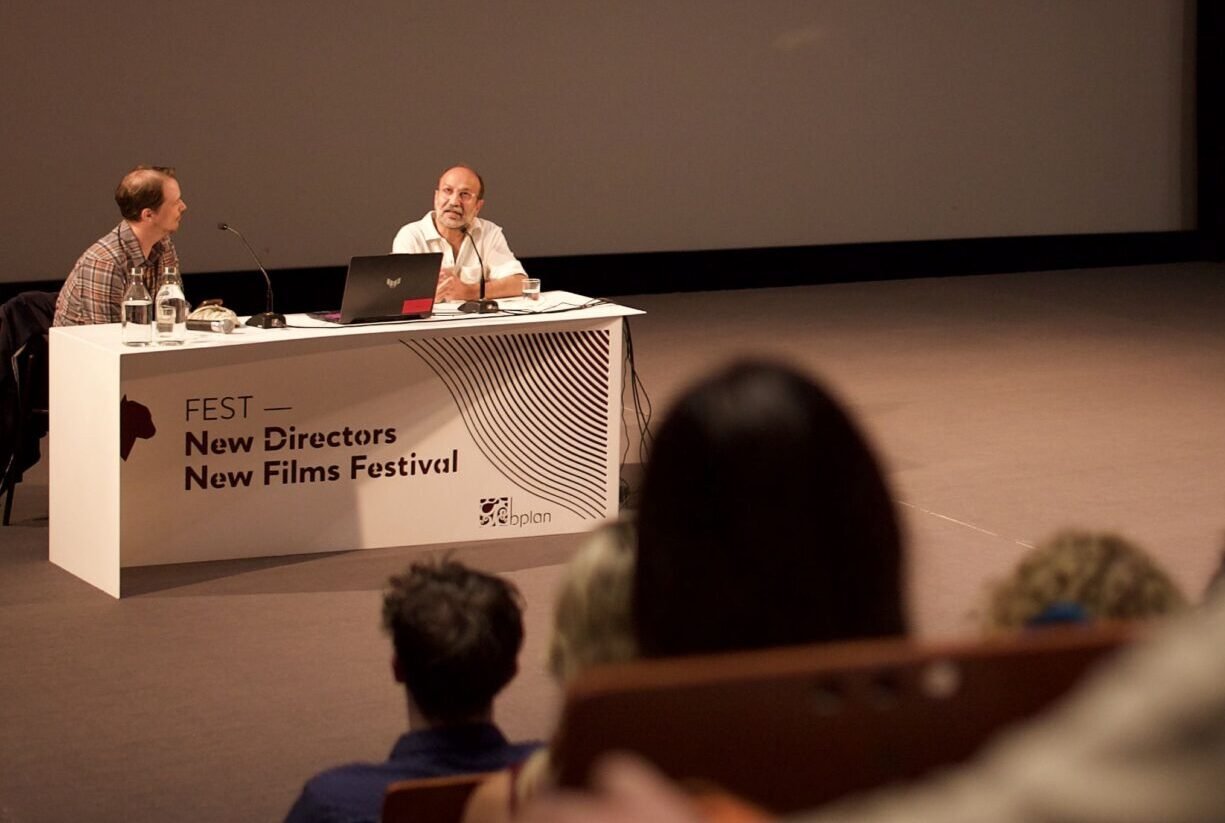

FEST — New Directors | New Films, in Espinho, has made the right bet on workshops and masterclasses, with a programme that goes beyond film screenings and has proved to be a successful model, attracting students and young people from all over the world, especially from European universities. The idea is to show the complexity of filmmaking practice in all its many dimensions. This year, for example, the guests included Katie Spencer and Sarah Greenwood, responsible for the set decoration and production design of Barbie; and Françoise and Mike Valentine, specialists in underwater filming. But the great star was the Iranian filmmaker Asghar Farhadi, director of About Elly, A Separation and A Hero, who gave a remarkable masterclass, conducted by William Brown, from UBC (Canada). It was a true lesson in cinema, which we summarise here in 15 topics, keeping as close as possible to the director’s own words.
1. Life as the Source
I don’t advise my students to watch three films a day. It destroys your creativity. You should watch films, you should read books, but precisely. The problem today is that many students watch so many films that they lose their taste.
Maybe better than watching films is watching people’s lives. If you follow someone in your family, or among your friends, from morning till evening, I am sure you will find a good story. The problem these days is that the source is cinema.
2. The subconscious
The main source is our subconscious. Many students and filmmakers make films from their mind, from their information, not from their heart. Then they lose their subconscious.
When we say subconscious, it does not mean we do not need learning or training. There are three steps: learning; trying to use that information and experience; and then letting it go inside, so that it comes up again as part of the subconscious.
3. What Theatre Taught Me
The most important thing I learned from theatre is unity of action, unity of subject. In classic plays, you have a subject at the core, and everything is around that subject.
Studying theatre was a big chance to read plays and to understand details that you cannot find in cinema. One of the things I found in theatre was the meaning of silence. Silence does not only mean not talking. Sometimes characters talk a lot, but the atmosphere, the feeling, the result, is silence.
4. Starting from the Situation
There are two methods. You may have a very interesting character, someone from your family or friends, and try to find a story based on that character. Or you may have a situation, a crisis, and then find the characters. I believe the second method is better: based on the situation, on the crisis, you find the right character for it.
I start by thinking and putting notes on a board, on small pieces of paper in different colours. Some ideas I am sure about, and that I love, are green. Some are yellow, because I have doubts. Some ideas come to my mind and I am sure I will not use them.
Then I find a three-line treatment, with a beginning, middle and ending. Nothing about characters yet: just a group, a situation, something happens. Then I give it more detail: one page, three pages, fifteen pages. This becomes the synopsis. At that stage I do not think about whether it is a moral story, a story about Iranian society, or politics. I do not think about the content in that way.
5. Do Not Begin with Concepts
I do not start with concepts. I dislike films that begin with a concept. For example: I want to make a film about the problems refugees have in this country. Then you go and find a story based on that concept.
Every story, even the story a mother tells her child at night, has some concept in it. Later, in rewriting, you can add elements, signs, and those signs can give the audience the direction you want. But the story should not begin as an idea imposed from outside.
6. The Audience Must Judge
As a director, as a writer, I do not judge my characters. I give that responsibility to the audience. In this scene, the camera – the eye of the audience – is in the judge’s chair. I simply describe life. I describe this character, and in the end you decide who has more right.
For me, this is a very difficult part of writing: giving enough space to all the characters so that they can give their reasons for the decisions they make. When we say ‘grey character’, it does not mean someone who sometimes does good things and sometimes bad things. It means that even a character who makes bad decisions can remain grey if you give him or her enough time to speak, to defend himself or herself.
In many films there is a bad guy and a good guy. Sometimes I think that if we remade those films and gave enough time to the bad characters, the remake might be the opposite: the bad guy might become someone we love.
7. Meaning Comes from the Right Place
We do not need to put meanings behind every detail. If you put something in the right moment, in the right place, the meaning comes. It comes from your experience, from your life.
This is also part of Iranian cinema and of our culture. Our culture is very indirect. Our language is not a direct language. We say one thing, and the meaning is something else. We do not show everything.
In many good Iranian films, important things happen outside the frame. You do not see them, but you feel them very sharply. Maybe this comes from that experience and that culture.
8. Let it happen
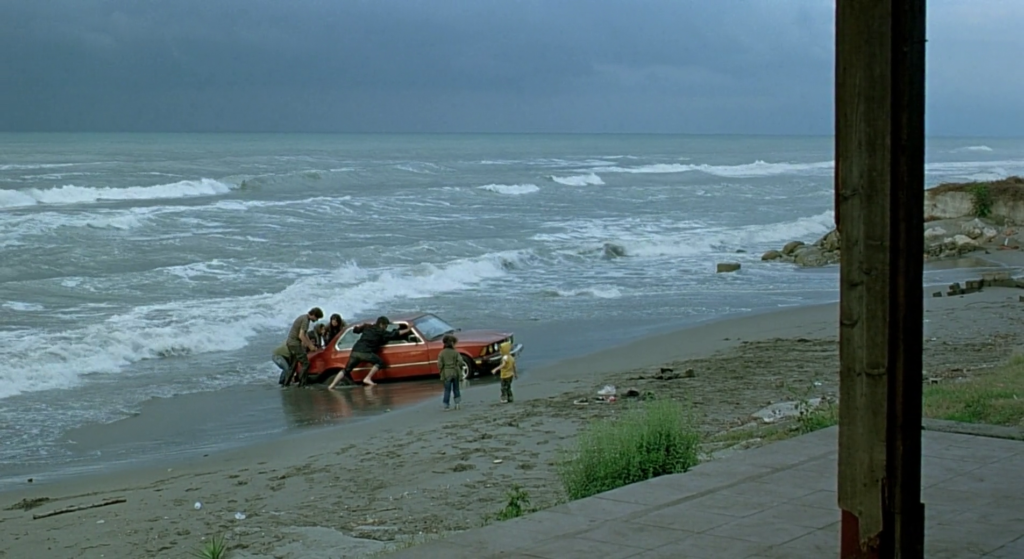
If you asked me to choose one shot from my whole career that I love, one that makes me happy and that I do not need to repeat, this would be it. Perhaps it is the best shot I have done. But it was not planned. It was not in the script. It just happened.
For About Elly, we rehearsed for three months, like a play, and then went to the north of Iran, to a villa, with the whole crew. I told the actors and the crew: every day, all of you have to be ready. Even if you have nothing to do, be ready, in costume and make-up. If I decide to do something different, you have to be ready.
That day we were working on another scene. I was outside, smoking, looking at the sea. The car was there; the water came in; the red car, the blue sky – it was a beautiful image. I do not know why, but I said: put the camera here. I called the actors and asked them to pull the car out. We did one take. My DP said: do one more, it is 35mm and maybe we lose it in the lab. We did the second take. When I said ‘Cut’, I immediately said: this is the final scene of the film. And it became the final shot.
Your heart has to be open to links with the environment, with the set, with people. The actors and technicians are human beings. Sometimes they see something that you, as a director, do not see. If they come to you and say something, be open.
This does not mean we should not be prepared. Everything should be prepared. You have talked about everything, worked with the actors, spoken with the DOP and the crew. But that is only fifty percent of the job.
9. Freedom for Actors
At the beginning of rehearsals, you can see whether an actor is thinking only about his or her own part, or whether he or she can think about the whole scene. Some actors think about the atmosphere, about the other actors and the other characters. Some think only about themselves.
I do not give much freedom to actors who only think about themselves. I respect them; if they say something, I say: okay, I understand. But I know it often gives me the wrong direction.
When actors can create a distance between their character and the scene, when they can see the general feeling of the scene, then I give them freedom.
10. The Emotional Basis of the Set
I advise young filmmakers to work with people at the same level as themselves, so that they can feel comfortable on set. That is very important – not only with the DOP, but also with the actors.
Emotional relationships are the basis of our work on set. With my crew on A Hero, my last film in Iran, we became like a family. On the last day, the whole crew were crying and hugging each other. It was very emotional.
11. Children and Emotional Space
When you have child characters in a scene, you develop its emotional space. For the audience, children are very important. If a couple is fighting and a child is there, you do not look at the fight – you look at the child, and you worry about the child.
Children create a strong connection between the audience and the film. Because they cannot defend themselves, we feel responsible for them. That is why I have them in my films. Sometimes I add one more child to make the emotional space larger.
Every time I work with children, I say: this is the last time. It is too difficult. But when I see the result, I say: they are great. With children, if they have an important line or moment, you need to create a situation for them. Do not rehearse too much. Even with adults, if an actor is already doing a good job, you do not need to touch them.
12. What Comes from the Heart
If something comes from my childhood, from my heart, or from people I know, the result will be more effective. There is a Persian saying: something that comes from your heart goes and sits on the audience’s heart. A word that comes from the heart, from the subconscious, can reach other hearts.
We should find ourselves and tell the stories that are important to us. I see people making films about things they have never experienced, subjects they have no real link with. But because producers and festivals like those subjects, they follow that path. Then the work does not come from the heart, from their life. It comes from the media atmosphere.
All of us have an emotional safe-deposit box inside ourselves, but we have lost the password. We have to find the key. Most of the investment in this emotional bank comes from childhood. So maybe the first step is to know ourselves, to go back to ourselves. If you do not believe it, do not make it. It will not work.
13. Seven Takes
Sometimes you go to the set and want the actors to do something you have in your mind. You repeat it: one, two, three, four, five, six, seven takes. If it goes beyond seven, which is my average, then something is wrong with you as a director, not with them. You have to change something.
When it goes to eight takes, I say to the crew: I need five minutes to think. I do not know what I should do. Being honest helps you on set. If you are not sure, tell the crew: friends, I need ten minutes to think about this shot. They will respect you. Instead of doing ten more takes, you take that time, do one more take, and get the result.
14. Finding the Camera Through the Actors
Camera movement and technical things are very important, but on set I always start with the actors, while the camera crew and the camera are still outside. When I am sure about the movement and the way the scene plays, then I ask the crew to come in.
First, I ask the actors to do the scene without emotion, just mechanically: you come here, you sit here, you move there. Because they know their characters, they start to move. I watch them and make small adjustments. After doing this several times, I explain some emotion, but not too much.
For about seventy percent of a scene, I do not have the blocking in advance. I go there and look. In A Separation, I sat down, watched them, and did not move. I said to myself: I did not move, so the camera should be here. Sometimes the best answer to why the camera is there is: I don’t know. I feel it is better.
15. Structure and the Right Place
Something that is very interesting to you tonight may not be interesting tomorrow. Give the scenes time: one week, one month. Then go back and read them again. You may say: this is not interesting, it is just fake emotion. Then you take it down.
You pick the papers one by one, put them together, and create the timeline of the film. Here is this scene, here is another scene; between them I need something. You put an empty paper there, so you know there is a gap. Then you find the structure.
Structure is more important than narrative. If a scene comes too late, it loses power; if it comes too early, it also loses something. Each scene has its right place, and you have to find it.